Showing posts with label White-vented Myna. Show all posts

Saturday, October 2, 2010

Mrs Treeswift

I, again, did some shots of the Crested Treeswift in front of my dad's work place. This time there were just a few male birds, only 2-3 maybe, and all of them perched quite far away from the flyover, so if you want to see the males just visit here. Several females were contrastingly perching very close to the flyover. I could even use fill flash with them, since the direction of light was not perfect. These females have plain slaty cheek unlike the males.

These photos are of the same individual from different angle.

Here's another individual stretching

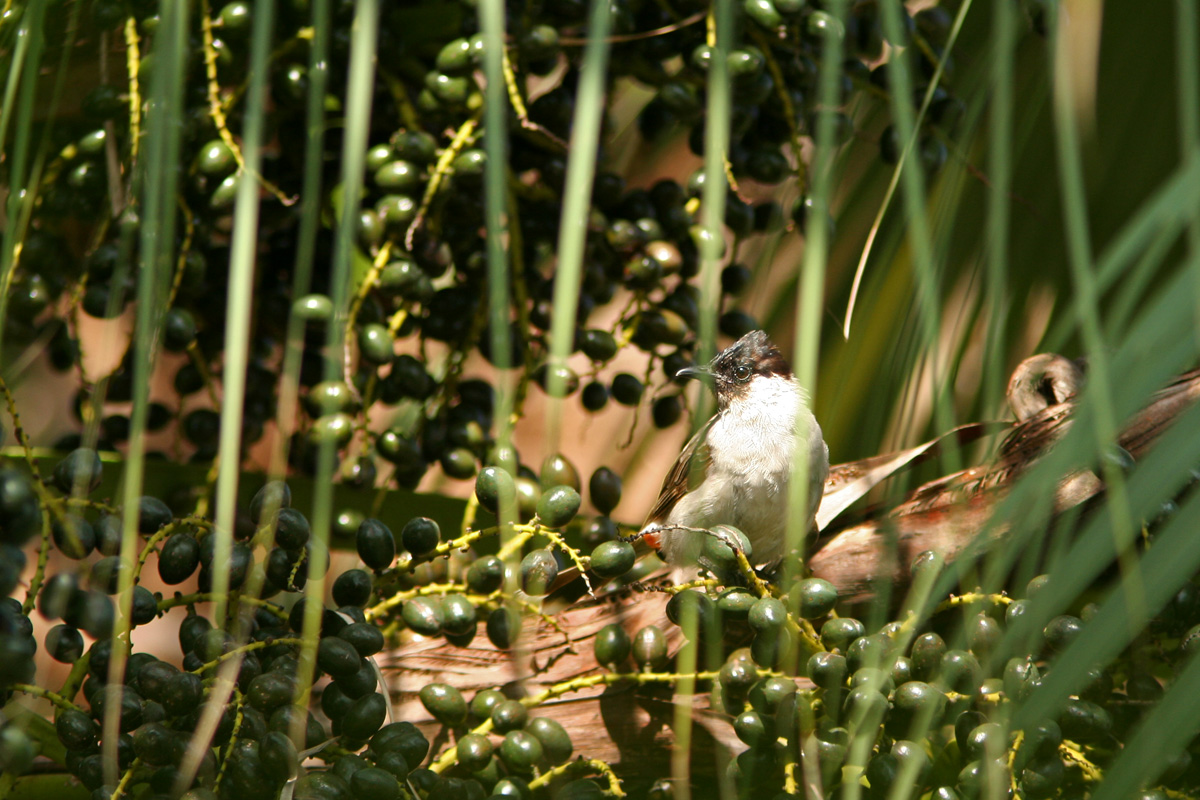
Apart from the treeswifts, there were quite many birds visiting the fruiting tree nearby, including Sooty-headed, Streak-eared and Red-whiskered Bulbuls, Common and White-vented Myna, Black-collared Starlings, Eurasian Tree-Sparrows and Zebra Doves. Below are some photos of the few species mentioned.

Sooty-headed Bulbul (Pycnonotus aurigaster klossi)

White-vented Mynas (Acridotheres grandis) with their cool hair styles.

Wednesday, September 29, 2010

Feels Like Early Winter

I've been back to Japan again since yesterday and trying to catch up with all the photos I took during the last few days before leaving Thailand. I went out birding daily every morning starting from 7 to 10am. I often rode my bicycle to a place in Muang Chum village where I often find some good migrants. The shots in this post were all taken on the sunny 21st September.

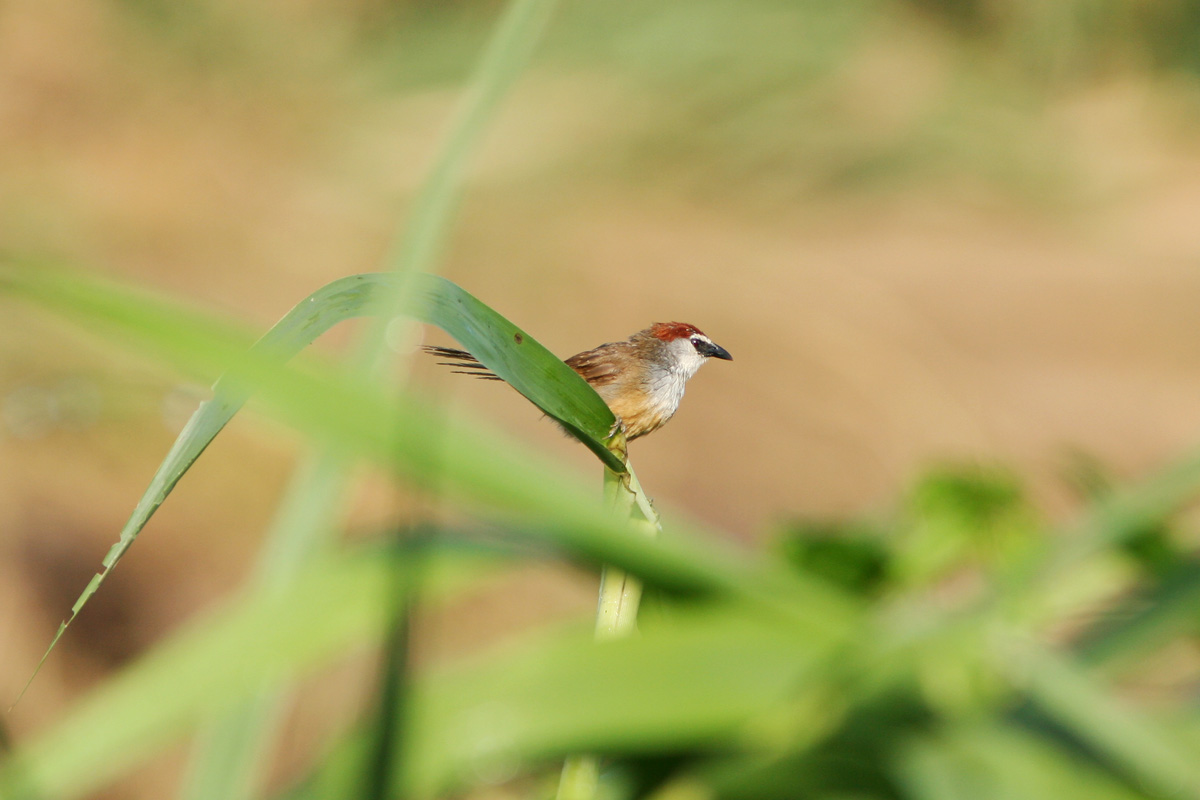
Chestnut-capped Babbler (Timalia pileata)
Little Egret (Egretta garzetta)

I often start off by visiting Mad Taeng River first then riding straight to Muang Chum. Along the reedbeds near the river, I was so happy to find a strong population of Chestnut-capped Babbler, a species of which I don't see very often. A pair came feeding near the main road and I luckily got them good under the sun. It is not very easy to see this bird in the open.

When I arrived at the place in Muang Chum, I unexpectedly spot a Eurasian Wryneck (Jynx torquilla) perching low in a dense Sensitive Plant bush. It was my first wryneck of the season and I was happy to get it in good light with nice blue background of the mountain, although the foreground was too messy. The last shot in the lower row shows the bird's tongue!

Monday, August 23, 2010

My Place

I've been calling it 'my place' for many years now. Cho Lae is a small village located only about 15 minutes away from my house. It is a good birding place where I used to visit several times a week during my high school period. It holds a vast cultivatied area, mainly rice paddies, bordered with dry dipterocarp forest and Mae Ngat Dam. Lots of interesting species can be found here, especially in winter, where the first Red-headed Bunting (Emberiza bruniceps) of Thailand and South-East Asia was found by me and a group of Malaysian birders.

I've been back to Cho Lae again last week with A.Mark, a new and extremely keen bird photographer in Chiang Mai. There were not so many birds as we arrived there a bit too late. There were several fruiting trees including mistletoe and calabura tree. These attracted lots of small Scarlet-backed Flowerpeckers (Dicaeum cruentatum) to come and feed on the fruits. One young male was obliging enough for me to get some good photos at close range. The adult male is the one in the far right photo of the lower row. Other fruit-eating birds like Purple and Olive-backed Sunbirds, Sooty-headed and Streak-eared Bulbuls also visit these fruiting trees as well.


A large flock of about 100 Barn Swallows was also resting along the electrical wires on the roadside. Cho Lae is another place where these birds gather in large flock during winter. Barn Swallow is among the very first migrants that arrive Thailand along with the Grey Wagtail and waders. I spotted several juvenile birds perching on low wooden poles, so I walked in and grabbed few shots. These juveniles are much more obliging than the adults.

There were already lots of Wood Sandpipers (Tringa glareola) in the rice fields. These birds are super hard to photograph since they always hide within the rice fields and flush up before we even see or get close to them. I spotted a different wader which is smaller and has black line on its rump unlike the Wood Sandpiper, and I thought it was a Dunlin, which I've seen earlier many years ago around the area, but since it's a rare species in Thailand, I want to be more sure to say that. A single unidentifiable Swinhoe's/Pintail Snipe also flushed up from the rice field as I walked in as well. This might mark as the earliest record of the snipe for me.

The highlight of the day was the shy Greater Painted-Snipe (Rostratula benghalensis). We flushed 1 beautiful female and at least 3 male birds. These birds are even more difficult to get good pics than the waders. They know how to hide away from human eyes very well and I still need to get some decent shots of them. The bird in the photo is the female. Male bird is much duller with plain brown head and neck similar to phalaropes where females are much more beautiful.

Other decent birds that showed up that day included the migrant Blue-tailed Bee-Eaters ,which were all too shy for us to take some pics of them, and several singing Bright-headed Cisticola. The most common bird was the above White-vented Myna (Acridotheres grandis) which seemed to be so active in finding food along the dikes. There were lots of its relative, the Black-collared Starling, as well but they all stayed away from me and my lens.


The last species of bird that we luckily came across was the Baya Weaver (Ploceus philippinus) which was having a nesting colony near the roadside. These birds can amazingly weave their own nests out of grasses in a very neat and beautiful way. We found at least 4 nests hanging on the top of a Tropical Almond (Terminalia catappa) tree. Few female birds also came in with lots of preys in their beaks and made the alarm call as they saw us standing under their nests. We then left the area quietly so the birds could get in and feed their chicks.

Tuesday, March 30, 2010

Morning Buffet

The only place where I did spent time birding was around the resort area. There's a fruiting fig tree just near by the parking lot and lots of birds visited the tree every morning. The most numerous species being the abundant Common Myna and Yellow-vented Bulbul, then the local Asian Glossy Starling (Aplonis panayensis) and the sweet Pink-necked Green Pigeon (Treron vernans). The White-vented Myna was quite common too. Ten years ago the species was still scarce in the southern part of Thailand, but nowaday it has become common throughout the country. Several Coppersmith Barbets also joined the party, one of them was juvenile. An adult and a juvenile Black-naped Oriole (Oriolus chinensis) visited the tree briefly in early morning. In the sky were Germain's Swiftlets, Blue-tailed Bee-Eaters and Brahminy Kites. I walked along the road to the beach and saw a couple of Common Moorhen, a White-breasted Waterhen, Pacific Swallows, a Common Kingfisher, Brown-throated Sunbirds and a striking Slaty-breasted Rail (Gallirallus striatus) in a canal along the way. At the beach I unexpectedly came across a female Barred Buttonquail (Turnix suscitator), a species which I've always wanted to take photos. Unfortunately the male bird which was hiding well on the ground nearby flushed up before I could spot him. Here are lots of photos mainly taken from the fruiting fig tree, a truly morning buffet for the birds there.
A male Pink-necked Green Pigeon

And a female

White-vented Myna

An adult Yellow-vented Bulbul

And here's a juvenile

My favourite pic of Common Kingfisher

A female Barred Buttonquail; male bird lacks black patch on the throat

Asian Glossy Starling likes to perch on exposed electrical wire.

But it's a tough bird inside the fig tree.

Juvenile bird looks totally different, except for those red swollen eyes.

A bright adult Black-naped Oriole

And quite a tamer juvenile

Coppersmith Barbet

Southern Jungle Crow

More Yellow-vented Bulbuls

And another male Pink-necked Green Pigeon

And I'll finish the entry by this super tame Zebra Dove

Unfortunately I didn't bring my 300mm lens with me during the last day, so I didn't get any photos of the tame Forest Wagtails at one of the view points. I guess they're on migration because I don't usually see them in flock like this. I also missed a large flock of frigatebirds which came soaring above the Phromthep Cape in the late evening and a pale morph Booted Eagle on the way back to the airport. Damn it.