Showing posts with label White-breasted Waterhen. Show all posts

Sunday, September 25, 2011

In The Fields

I spent most of the time birding around the paddyfields in my local patch during the vacation. Now I'm back in Beppu, so I have to clear up those photos I took. Even though it had been raining a lot in Thailand, I actually liked it because it made the air much fresher and cooler, just perfect for a morning bicycle ride. I expected to see some interesting migrants but it seemed a bit too early for them. If I stayed in Thailand until the end of this month, there might be more chances for me to see some decent migrants. The most interesting one I saw was a single adult Chestnut-winged Cuckoo (Clamator coromandus) briefly landed just a few metres away from me and flushed out on the very same second it landed on the perch. It's a shame I couldn't get any photo of it since it's a very beautiful cuckoo as you can see here.

Male Yellow-bellied Prinia (Prinia flaviventris delacouri)


The same male Yellow-bellied Prinia (Prinia flaviventris delacouri) was still doing well protecting its own territory. I went back again with a tripod to get some more videos of the bird and the result is as above. Please try selecting the HD 1080p to fully enjoy the pleasure of viewing. There was also another juvenile bird hopping around in the same bush. I assumed it was the fledgling of this handsome male bird.

Juvenile and adult Chestnut-capped Babblers (Timalia pileata smithi)
A common birdscape; 3 Spotted Doves and a Long-tailed Shrike (L.s.tricolor)
Lesser Whistling-Duck (Dendrocygna javanica)
Male White-breasted Waterhen (Amaurornis phoenicurus)
Birds in my local patch were quite stable. All the familiar faces were still presenting well, especially the hyper-active Chestnut-capped Babbler (Timalia pileata smithi) family. The juveniles still seemed to hang out well with their parents even though they should be ready to live by themselves. A few Lesser Whistling-Ducks (Dendrocygna javanica) were staying in a small flooded area among the giant mimoca bush. I tried to get some good photos of them but they always swam into the bush right before I could get any decent shot. The above photo was my best try. A family of 2 adult and 2 small White-breasted Waterhen (Amaurornis phoenicurus) chicks and a juvenile Cinnamon Bittern (Ixobrychus cinnamomeus) were also staying in the same area.

Juvenile Cinnamon Bittern (Ixobrychus cinnamomeus)

Adult and juvenile Scaly-breasted Munias (Lonchura punctulata topela)
Male Oriental Magpie-Robin (Copsychus saularis)
On the same day that I photographed the Black Baza at Mae Hia in the post below, I also got a chance to see a pair of Small Asian Mongooses (Herpestes javanicus) out in the open. It is very difficult to see this shy mammal in the open especially for a long period of time. I normally see them running away into the bush or swimming away, as they're also a good swimmer. The pair that I saw seemed to be interested in something in the paddyfield below. There were 2 White-breasted Waterhens, a Red-wattled Lapwing and 2 Chinese Pond-Herons trying to mob the mongooses, so I guess they were interested in something belonging to one of these birds. One of the mongooses was smaller with much darker fur and another one was larger with more brightly rufous fur. I realised that the smaller one was a female as they even performed a mating scene several times before disappearing into the grass.

Small Asian Mongoose (Herpestes javanicus)
And the rare mating scene!

Tuesday, September 6, 2011

In The Grass

Of course, not only the White-breasted Waterhens that were photographed, I also brought back photos of few other species home with me on the same visit as well. In a small grassy area close to the place where the waterhens were found, a large flock of Baya Weavers (Ploceus philippinus angelorum) mixing with Scaly-breasted Munias (Lonchura punctulata topela) was also feeding on grass seeds. The former is the less common one and I've always failed to get any decent shot. The weavers are very wary and normally don't let me get close to them. I later spotted 3 old nests located around the large giant mimosa (Mimosa pigra L.) bushes on the other side. There were several female and juvenile birds checking out these nests, so I hid myself among the bush and waited and finally I could grab a few shots of them while coming to the nests.

Juvenile Baya Weaver (Ploceus philippinus angelorum)
Normally they would be avoiding camera like this...
There were lots of other birds in the giant mimoca bush as well, including Streak-eared and Sooty-headed Bulbuls, a pair of Grey-breasted and Plain Prinias, a single Lesser Whistling Duck which was circling around all the time, several Cinnamon and Yellow Bitterns, and another White-breasted Waterhen family, which I also came across a very young chick running on the road. The chick was still fully covered with black down. It quickly ran into the bush where it was later accompanied by its parent.
Streak-eared Bulbul (Pycnonotus blanfordi conradi)
White-breasted Waterhen (Amaurornis phoenicurus) chick
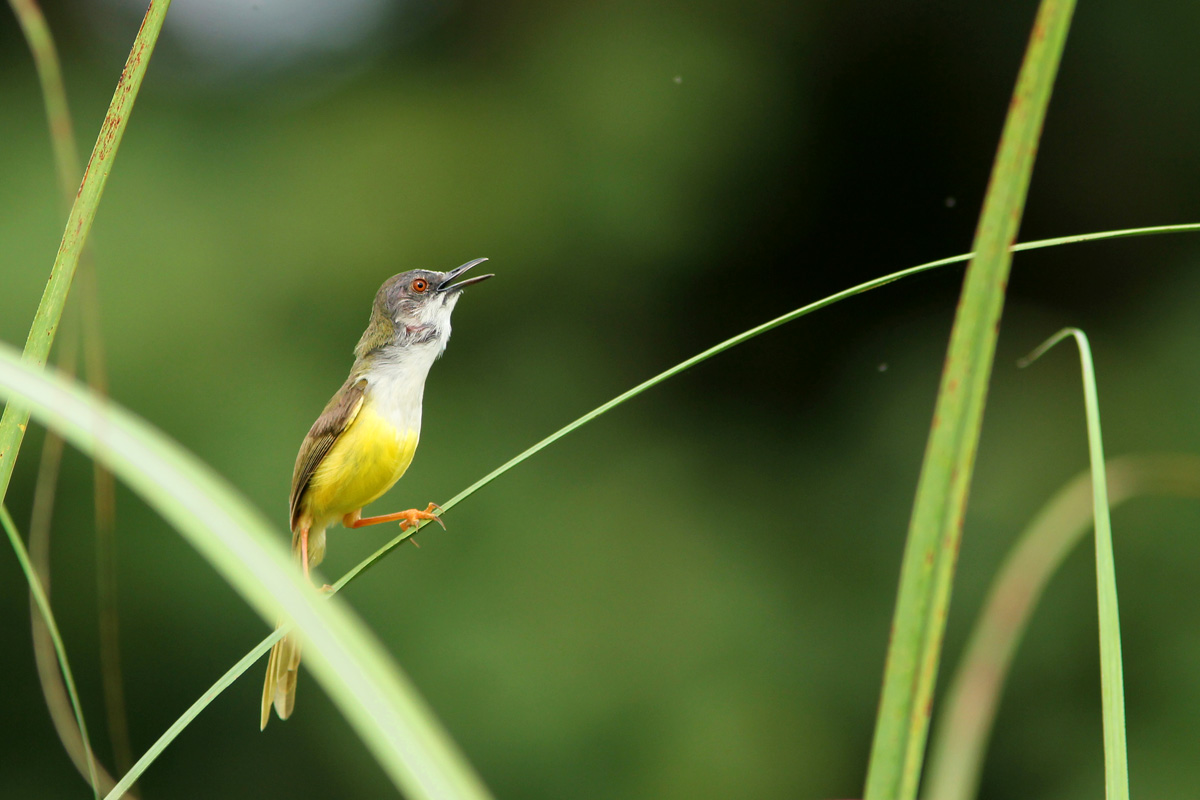
As I was about to leave, I spotted a male Yellow-bellied Prinia (Prinia flaviventris delacouri) singing its heart from the top of the grass. It is definitely another colourful common bird that I can never get bored of looking at. I even took a few shaky handheld videos of it, and after processing through a video editing program, they've become quite acceptable. There was also a young juvenile bird hiding in the same bush as well. I guess it's the fledgling of this handsome male bird. The Yellow-bellied Prinia is a very territorial bird, so I quickly grabbed as many shots as I could and left the area to reduce the stress of the bird.

Male Yellow-bellied Prinia (Prinia flaviventris delacouri)

Below is a video of the bird singing. Feel free to select HD 1080p!

Friday, September 2, 2011

Morning Waterhens

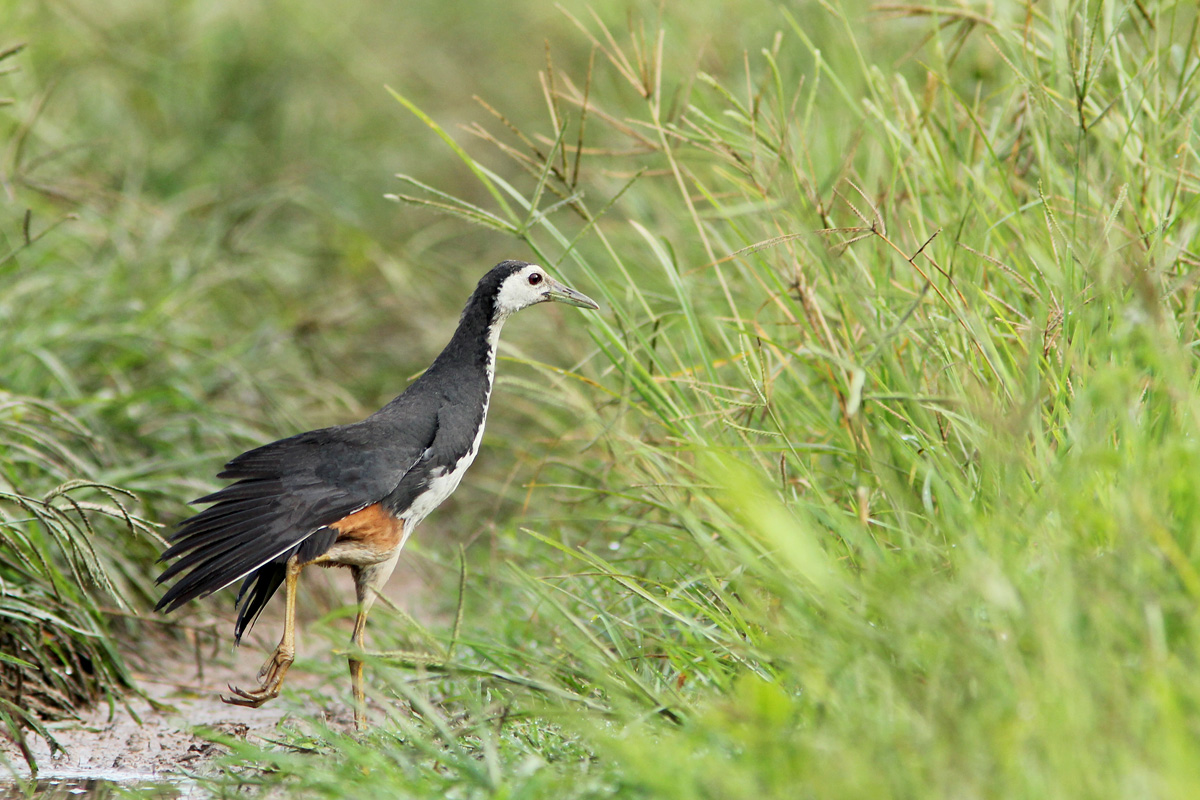
The White-breasted Waterhen (Amaurornis phoenicurus) is a very common crake that can be found throughout Thailand. I was kind of surprised when I found that it can also be found in Japan as well, though only in Okinawa. I didn't expect this species to spread all the way up to the northern hemisphere. Its dark slaty back quickly disappearing into the grass is a common sight I often see whenever I go out riding through the fields. Even though it is so common, I've still never got any good photo of it. Two days ago, I went riding through the same route checking my local patch. I decided to ride a bit further and explore more suitable sites for birding. I ended up in a small muddy road leading into the rice fields, and found a pair of this black and white crake busy looking for food.

White-breasted Waterhen (Amaurornis phoenicurus)

At first, there were 2 birds walking together on the road. One was presumably male with brighter coloured bill, and another one was presumably female with duller greyish-green bill. The one being shown here is the female. The male was much shyer and didn't return to the same spot after disappearing into the grass, unlike the female which came back to the same spot repeatedly, and didn't care much about my existence. I slowly crept towards the bird, and though it might be walking away, I'd wait until it came back to the same spot again. I enjoyed shooting photos of this relatively tame bird for about 10 minutes until it slowly disappeared into the thick vegetation on the roadside. On the next day, I discovered that the pair was actually raising 2 fluffy chicks which were both too fast for me to snap any record shot. Both of the chicks were already quite grown up and developing some white feathers on its neck and belly. I also came across another lone chick further on the road. This one was much younger and still fully covered with black downs feathers.
Presumably male bird in the back (with brighter red knob)
I observed it feeding on earthworms and grass seeds.

At times it came really close to the camera.
My favourite shot to end this post. I just love those dewdrops on the grass.