Showing posts with label Green Pheasant. Show all posts

Thursday, December 29, 2011

The National Bird

More than 40 countries now have their own national birds. I was a bit surprised when I first learned that the Green Pheasant (Phasianus versicolor) is Japan's national bird. Usually when thinking of a Japanese bird that can represent Japan well as a whole, I'd think of the Red-crowned or Japanese Crane (Grus japonensis). Just look at its scientific name and those cliches of white large birds dancing in the snow. However, to my surprise, the Red-crowned Crane is actually China's current national bird. And because of the scientific name issue, I've heard people said that China might choose a new national bird. The Golden Pheasant is among the top candidates. I actually agree with this choice. Either the Golden Pheasant or Mandarin Duck would suit fine as their national bird. Anyway, in Japan it seems like the image of the Green Pheasant is not as widely celebrated as the cranes or eagles. I barely see photos of the pheasant in general media, while every winter there are photos and footage of the cranes, both in Hokkaido and Kagoshima, almost everywhere. It's the reason why I haven't been aware that the Green Pheasant is actually the Japanese national bird.

Male Green Pheasant (Phasianus versicolor)
On December 27th, I visited Oita River hoping to photograph some wintering ducks as usual. There were not so many ducks in the river, however. The star bird that completely stole the show of the day was actually the male Green Pheasant that was feeding along the river bank. Actually, there were at least 3 of them. They were quite vocal and once I thought I was about to witness the real cockfight when 2 of the birds began to scream at each other very seriously. It turned out that both of them chose to stay in the shade and scream at each other for about 10 minutes attracting the attention even from the pedestrians before they both stopped and disappeared into the dense vegetation.

Looking from the photos above, you might think that it's an easy job to photograph the bird as it seems to be out in the open, but actually it wasn't easy at all! Even though the birds seemed to favour foraging in the open and neglecting the pedestrians and bikers, they were certainly scared of me pointing large gun-like object towards them. They don't fancy flying much, so most of the time they just slowly (or sometimes quickly if I got really close) crept into the bush. Once they're in, it's not an easy job to get their photos. I had to listen to the sound of them walking through the grass and figure where and when will they come out. It was a fun experience though.
Their typical 'checking out' look

It's really difficult to get the whole body into a frame!
Sometimes they liked to cross the street too, but it's still not easy to capture them while they're switching on their high speed gear. I think the best way to photograph them is to be in a car, since they seemed to neglect vehicles like motorcycles or bicycles and people who were running. It was quite a crazy moment when I was running around chasing after a pheasant that was running wild on the open street. I wonder if anyone saw the whole sequence of that they'd be laughing their heads off. Just running after a pheasant on the street is already funny enough, not to mention of trying to photograph it. Below is how the bird behaved. You can see that it clearly doesn't care standing in the bright light if the people just keep on passing by, not stopping in front of them with a bazooka their hands.
Just keep passing, people!

Today I went to Ono River at Shimohanda because someone found a male Scaly-sided Merganser (Mergus squamatus) since about 2 weeks ago. I just found the news this morning and hurried out of the room to get there as soon as possible. The Scaly-sided Merganser is one of my most yearning birds. The last record of it was on Monday December 26th, only 1 day before I went to Oita River to get these shots of the pheasants. I kept thinking to myself I should've known this news earlier, since the bird didn't show up today. It was even published on the local newspaper! This is the first record of this endangered species in Oita Prefecture in 4 years. I even met the guy who first found the bird and he took me to the place where he normally used to observe it, but it wasn't there. Just looking at the photo of it in his website makes me feel a little heartache. I was a totally failed twitcher today. Even though I found a beautiful male Baikal Teal and a flock of 10+ Mandarin Ducks, they didn't make me feel any better.

Monday, January 10, 2011

Oita River

January 2nd saw me catching a train to Oita since early morning. I wanted to take some photos of the tame ducks at the same spot I took last year. Unfortunately, the tide was too low and the ducks were all floating far in the middle of the river. A few Common Teals and Northern Shovelers were swimming around closely in the area though, but they happened to be so much shier than last year, so no photos taken. The weather was great, by the way. A bit windy, about 10km/hr, but not very cold, and the sun was shining brightly for most of the time too. There were lots of Great Cormorants (Phalacrocorax carbo) roosting on the rocks along the river. As the sun slowly rose up, even more of them came flying in from the sea direction.


Great Cormorants (Phalacrocorax carbo)
I remember seeing the description for the Great Cormorant in a Japanese Bird Guide, which I borrowed from my birding pal, noting Oita Prefecture as one of the well-known breeding sites of this species in Japan. I think that's the only line where the name Oita is mentioned in the book. Anyway, that's just me trying to feel good about having just a few other birds to photograph on that morning other than the cormorants.
Beppu Ropeway viewing from Oita River

Even more photos of the Great Cormorants
Male Baikal Teals (Anas formosa)

Wednesday, June 2, 2010

Chasing "Kiji"

Talking to the old lady that day gave me a lot more information about birding spots in Beppu. She showed me her photo albums of birds taken only in and around Beppu. There were lots of species I've never seen before, and I really want to see as well. These species include Japanese Paradise-flycatcher, which she found a pair nesting, Falcated and Mandarin Duck, which both exist in Sekino-e where I often visit, Brown Dipper which again she also found a nest and Japanese Green Pheasant or race versicolor of the Common Pheasant. The place where she found the paradise-flycatcher, dipper and pheasant is called Asami Sanchou-me(朝見三丁目) which is quite near Beppu park. I visit the place very early this morning and searched for those 3 precious species but failed miserably. It was when I eventually gave up hoping for those birds, a very beautiful male Japanese Green Pheasant walked out of nowhere in front of me. Fortunately, I was quick enough to grab a few shots of the bird before it flew down to the bush below.
Too bad the original background of the photo includes typical Japanese house with electric pole and wires. Thanks to the technology, I could remove all those unwanted objects and replace them with a plain green background hehehe.

Oh and I almost forgot to tell you that the word "Kiji" in the title is the Japanese name for this pheasant. It is also the national bird of Japan. After that first few shots I got when the bird was surprised by my appearance, I couldn't get much better shot than that. It was very shy and I just had to walk up and down the hill chasing after it for the whole morning. Anyway, I can leave it for the next visit to getting some more shots of this beautiful bird.

Tuesday, January 19, 2010

River Side Birdwatching

So this entry is gonna be talking about birds at Oita River other than the ducks. I arrived there a little earlier than usual, about 8am. This time I tried using bus from Beppu to Oita Eki and it took about 30 minutes, about 15 minutes slower than the local train. There at the river side, lots of Eurasian Skylarks (Alauda arvensis) flushed up from short dry grass as I walked. They were difficult to get good pics since they always tended to hide in the grass and hardly let me get close. Some of them were already started singing both on the ground and circling up in the sky.
A skulking Eurasian Skylark

A non-breeding Buff-bellied Pipit (A. rubescens japonicus)

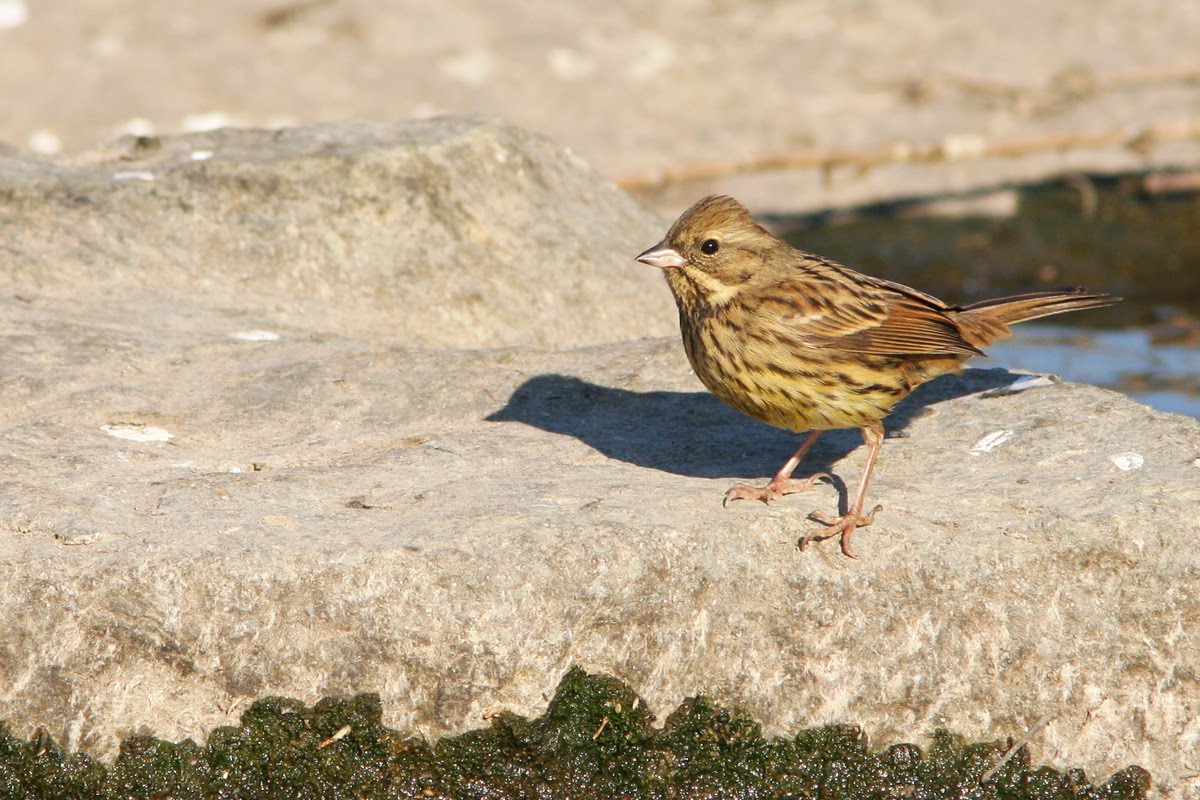
A singing male Meadow Bunting

And some more shots of both male and female

There were a group of about 20 Eurasian Wigeons feeding near the bank and lots of White-cheeked Starlings flying around as usual. I walked across the bridge to the other side of the river and found many Meadow Buntings feeding along the bushes next to the footpath. Most of them were in pairs and some males even started singing their sweet songs giving a sense of spring in the air. Along the reeds, the much shyer Black-faced Buntings(Emberiza spodocephala) were also seen in a good number and even the Reed Buntings(Emberiza schoeniclus) were also presented perching on a dead tree with the Grey-capped Greenfinches.

A Black-eared Kite sitting still warming itself up with warm morning light

I was puzzled with this 2cy gull which came circling around the place where I photographed the ducks for several times. It looked very snowy like a first-year Mongolian Gull but too many features didn't seem to fit in very well. It's a second-year bird judging from its adult grey mantle feathers, but other parts of it still seemed to be those of the first-year. Its black tail-band was too broad with no sign of double tail-band like typical Mongolian and the streaking on the head kinda look like a Vega. I'm still wondering what could this one be, a pale Vega? Hope someone can help me with this puzzling gull...

*Edited: Thanks to Mr.Ujihara from the Japanese Gull Site for identifying this gull and it's a second year Common Gull (L. canus). I didn't think of the species at all at first because I felt that the size of this bird was equally big like one of those herring gulls. He also pointed out the simple upperwing coverts pattern of the bird which indicates that it's not one of the herring gull group.

Some more photos of the same juvenile gull

A surprise of the day was a single non-breeding adult Long-billed Plover (Charadrius placidus) which was standing at the place where I photographed the ducks. Though it is classified as common resident, this was the first time for me to see the species in Japan. Maybe it's only scarce in Oita and Beppu...just like every species elese. It's actually a rare winter visitor to northern Thailand and I've been to Mekong River in Chiang Saen to twitch it once. That time I only saw a juvenile, but I've also seen several adults at Arunachal Pradesh in India. Surprisingly the bird was very wary and I had difficulty trying to get closer to it. It didn't seem to be hungry at all, or was it just too afraid of my presence that it didn't change its posture at all so my excitement completely disappeared after 5 minutes of watching it. What it did was just standing still at the river bank watching me and all the ducks that were feeding in the river, but everytime I tried getting closer to it, it would immediately fly away and come back in a minute or two.

This was the best I could get from the Long-billed Plover

Lots of female Bull-headed Shrikes were seen along the bushes with only 1 male bird, as well as the female Daurian Redstarts. It was strange I didn't find any single male redstart which is usually more common during winter. In the river was a good number of Great Cormorants as usual with few birds in their full breeding plumage. A pair of Common Kingfisher also presented along with another cute pair of Little Grebe in the same small pond. Ospreys were common and a Peregrine Falcon was also seen briefly chasing some small birds.

This female Black-faced Bunting came down to the river in front of me while I was photographing the ducks. Shame the male bird was feeding in another area where I couldn't take any photos of.

I have no idea why this White Wagtail isn't white as its name.

Few more shots of the female bunting

And an Osprey

I was so surprised at the size of its prey. I later felt so sorry for this Osprey because it was chased by a flock of crows and a Grey Heron and dropped the fish down to the river. What a waste of effort. Thieves like these should be taught a lesson.

This Great Cormorant was already in its breeding plumage.

A female Meadow Bunting

And the biggest surprise of the day was this beautiful male Common Pheasant (Phasianus colchicus) which flew across the river and landed briefly on the sandbar before walking into the thick reedbed. It's the subspecies P.c.versicolor which can sometimes be called Green Pheasant and is the nominate race in Japan, a life bird for me as well. Though I couldn't get any decent pic but at least I know they exist here in Oita and I know where to look for the next time I come here.