Showing posts with label Black-faced Bunting. Show all posts

Saturday, December 10, 2011

A Bunch Of Unproductiveness

Even though I have already complained about the lack of birds during this winter in a few other posts, this post is also dedicated to the same topic. Sekinoe kept disappointing me so bad that I have lost my motivation to visit it again. I've been thinking of going to Oita River for a few days now, but I also fear of not seeing any decent bird. This winter seems to be much delayed too, so I am not sure if interesting migrants like the Baikal Teal that I found last winter or the Japanese Waxwing that I missed, have already arrived or not. Anyway, at least I have found 2 Beppu's firsts during this season, which are the Japanese Sparrowhawk (Accipiter gularis) that I found both at Hamawaki and Rakutenchi, and the Common Coot (Fulica atra) at Sekinoe and Furuichi.
Juvenile Japanese Sparrowhawk (Accipiter gularis) at Hamawaki on December 6, 2011.

Possibly different juvenile Eurasian Sparrowhawks (Accipiter nisus) at Sekinoe
The only Accipiter hawk that I've found in Beppu has always been the Eurasian Sparrowhawk (Accipiter nisus). This winter has been a little bit different because 2 Japanese Sparrowhawks were found in the southern part of Beppu including Hamawaki and Rakutenchi entrance. I was actually unsure about the identification of the bird in the first picture at first, but after sending it to a raptor expert, I was confirmed that it is a juvenile Japanese Sparrowhawk. It has different streaking and barring pattern on the underparts with a much shorter tail. Juvenile Eurasian Sparrowhawk has no vertical streaking on the breast with a much longer tail.
Male Common Teal (Anas crecca)

A flock of Common Teals resting in the afternoon

Eclipse male and female stretching wings

Comparing to other years, the number of waterfowls at Sekinoe is quite disappointing. Normally, a large flock of Common Teals (Anas crecca) would be filling the whole lotus fields by late November. However, this year there were only about 20 birds. There was a pair of male Mallards (Anas platyrhynchos) among the flock of Common Teals and a single Common Coot (Fulica atra) swimming in the river.I was so shocked to see the emptiness of the fields. Only a pair of Common Sandpipers, a lone Buff-bellied Pipit, a Grey Wagtail and a pair of Japanese Wagtail were found feeding in the fields at Sekinoe. Things are a little bit better on Furuichi side. I flushed up a single male Greater Painted-Snipe and an extremely shy Ruddy-breasted Crake was seen moving and calling in the grass.
Male Mallards (Anas platyrhynchos)
Ruddy-breasted Crake (Porzana fusca erythrothorax)
Male Daurian Redstart (Phoenicurus auroreus)

And the female

This year even the Daurian Redstart (Phoenicurus auroreus) which normally passes through Beppu in a large number seems to be fewer than ever. I've always got decent shots of this species during autumn either at Sekino or Beppu Park easily without much effort. However, this year it was more difficult for me to get any decent shot of the birds. Apart from these usual migrants, I also found a single Common Kestrel (Falco tinnunculus) soaring above Sekinoe field and a few Black-faced Buntings (Emberiza spodocephala personata) flicking within the reeds. It's the species that I'm still waiting to get a decent shot of. On my recent visit on December 4, I also found another Common Coot feeding in an open lotus field along with a small flock of Common Teals at Furuichi.
Common Coot (Fulica atra)
Male Bull-headed Shrike (Lanius bucephalus)
Common Kestrel (Falco tinnunculus)

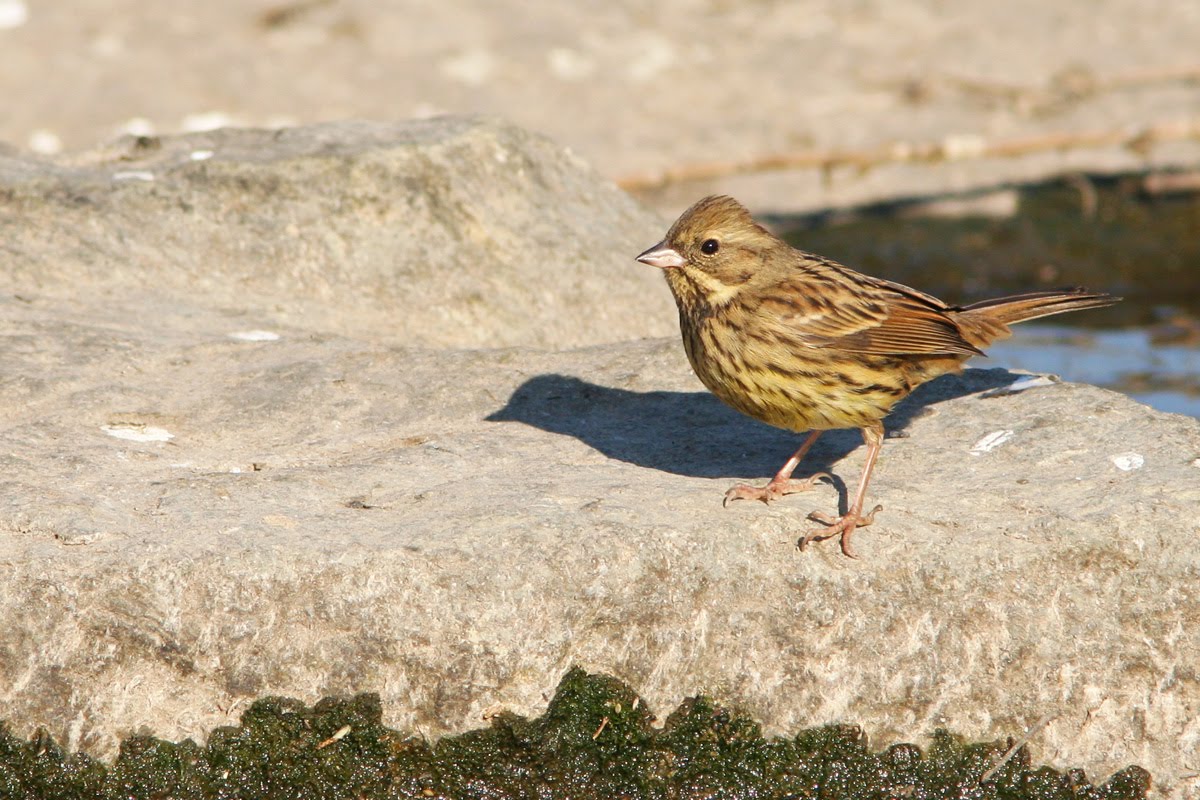
Female Black-faced Bunting (Emberiza spodocephala personata)

Thursday, April 8, 2010

Failed Attempt

After discovering the Japanese Grosbeaks in Minami Tatte-Ishi koen on April 3rd, the next morning I headed back again to the park. I easily located a pair of bird singing on a tall flowering tree, but the birds were too high for me to get any decent shot. They then flew into a thick tree and stayed there. Later I spotted a flock of 3 birds feeding on the ground with a single male Hawfinch nearby. The birds quickly flew out as soon as I tried to get closer to them. I followed them until they finally flew out of the park's area and that was the whole story of that day, another failed attempt for a bird.
The only shot before the birds flew out.

Brown-eared Bulbul

The cute Long-tailed Tit

A male Black-faced Bunting

A female Hawfinch

Pale Thrush

Apart from the grosbeak, the birds were actually pretty good. A wave of Japanese Pygmy Woodpeckers, Long-tailed Tits and Japanese White-eyes moved around all over the park. I spotted a female White-bellied Green-Pigeon flew by rapidly. A pair of male Black-faced Buntings was feeding along low vegetation near the park entrance. They were shy as usual, but I could get some better photos of them. Hawfinch and Grey-capped Greenfinch were common as the day before, and the 2 thrushes plus White-cheeked Starling were abundant as always.

Wednesday, January 27, 2010

A Cold Morning at Furui-chi

So I'm gonna finish up the photos from that visit on Sunday. It was a brilliant morning with beautiful sunlight, yet very very cold. It was so cold that the water in the lotus field was almost completely frozen, the first time for me as well to see frozen water pond. The Japanese Tits (Parus minor) were singing from high branches and electric poles and many Turtle-doves were flying around. Daffodils were everywhere and they really add a beautiful feeling to this already very lovely morning. A small flock of 3-4 Common Snipes (Gallinago gallinago) were gathering together in a small ice-free corner of the field and many were hiding along the dikes. I even saw one flying from nowhere then landed directly in the middle of the pond and funnily slipped on the ice. It must've thought that was water. A flock of about 20 White-cheeked Starlings was also feeding on a fruiting next to the railway, and a pair of male and female Bull-headed Shrike was also presenting around the lotus field.
The same pair of Black-eared Kite from the previous entry

A male Pale Thrush

A closer view of the Black-eared Kite

A group of Common Snipes

These snipes just had to wait until the ice completely melted.

A Japanese Tit (or Great Tit P.major minor)

I walked to the other side of the field to the Sekino-e(関の江) area and found a flock of Grey-capped Greenfinch feeding along with many Black-faced Buntings. I tried photographing them but these finches are always too shy to get good shots. Unlike the Black-faced, the Meadow Buntings around Sekino-e area were very approachable. They were all feeding in a small front yard of a house near the other APU's dorm. A male Black-faced Bunting also came aound but flew out too soon before I could get any better shot as usual. The teals were still around but in small number, didn't know where they've gone to. The surprise of the day was a flock of Reed Bunting in the small reedbed near the main road. This is the first time for me to see the species here in Beppu area.

A male Meadow Bunting

The only acceptable shot of the male Black-faced Bunting
Why can't they be all so tame like those Siberian Meadows?

A male Grey-capped Greenfinch

And a record shot of the Reed Bunting in Beppu!

Tuesday, January 19, 2010

River Side Birdwatching

So this entry is gonna be talking about birds at Oita River other than the ducks. I arrived there a little earlier than usual, about 8am. This time I tried using bus from Beppu to Oita Eki and it took about 30 minutes, about 15 minutes slower than the local train. There at the river side, lots of Eurasian Skylarks (Alauda arvensis) flushed up from short dry grass as I walked. They were difficult to get good pics since they always tended to hide in the grass and hardly let me get close. Some of them were already started singing both on the ground and circling up in the sky.
A skulking Eurasian Skylark

A non-breeding Buff-bellied Pipit (A. rubescens japonicus)

A singing male Meadow Bunting

And some more shots of both male and female

There were a group of about 20 Eurasian Wigeons feeding near the bank and lots of White-cheeked Starlings flying around as usual. I walked across the bridge to the other side of the river and found many Meadow Buntings feeding along the bushes next to the footpath. Most of them were in pairs and some males even started singing their sweet songs giving a sense of spring in the air. Along the reeds, the much shyer Black-faced Buntings(Emberiza spodocephala) were also seen in a good number and even the Reed Buntings(Emberiza schoeniclus) were also presented perching on a dead tree with the Grey-capped Greenfinches.

A Black-eared Kite sitting still warming itself up with warm morning light

I was puzzled with this 2cy gull which came circling around the place where I photographed the ducks for several times. It looked very snowy like a first-year Mongolian Gull but too many features didn't seem to fit in very well. It's a second-year bird judging from its adult grey mantle feathers, but other parts of it still seemed to be those of the first-year. Its black tail-band was too broad with no sign of double tail-band like typical Mongolian and the streaking on the head kinda look like a Vega. I'm still wondering what could this one be, a pale Vega? Hope someone can help me with this puzzling gull...

*Edited: Thanks to Mr.Ujihara from the Japanese Gull Site for identifying this gull and it's a second year Common Gull (L. canus). I didn't think of the species at all at first because I felt that the size of this bird was equally big like one of those herring gulls. He also pointed out the simple upperwing coverts pattern of the bird which indicates that it's not one of the herring gull group.

Some more photos of the same juvenile gull

A surprise of the day was a single non-breeding adult Long-billed Plover (Charadrius placidus) which was standing at the place where I photographed the ducks. Though it is classified as common resident, this was the first time for me to see the species in Japan. Maybe it's only scarce in Oita and Beppu...just like every species elese. It's actually a rare winter visitor to northern Thailand and I've been to Mekong River in Chiang Saen to twitch it once. That time I only saw a juvenile, but I've also seen several adults at Arunachal Pradesh in India. Surprisingly the bird was very wary and I had difficulty trying to get closer to it. It didn't seem to be hungry at all, or was it just too afraid of my presence that it didn't change its posture at all so my excitement completely disappeared after 5 minutes of watching it. What it did was just standing still at the river bank watching me and all the ducks that were feeding in the river, but everytime I tried getting closer to it, it would immediately fly away and come back in a minute or two.

This was the best I could get from the Long-billed Plover

Lots of female Bull-headed Shrikes were seen along the bushes with only 1 male bird, as well as the female Daurian Redstarts. It was strange I didn't find any single male redstart which is usually more common during winter. In the river was a good number of Great Cormorants as usual with few birds in their full breeding plumage. A pair of Common Kingfisher also presented along with another cute pair of Little Grebe in the same small pond. Ospreys were common and a Peregrine Falcon was also seen briefly chasing some small birds.

This female Black-faced Bunting came down to the river in front of me while I was photographing the ducks. Shame the male bird was feeding in another area where I couldn't take any photos of.

I have no idea why this White Wagtail isn't white as its name.

Few more shots of the female bunting

And an Osprey

I was so surprised at the size of its prey. I later felt so sorry for this Osprey because it was chased by a flock of crows and a Grey Heron and dropped the fish down to the river. What a waste of effort. Thieves like these should be taught a lesson.

This Great Cormorant was already in its breeding plumage.

A female Meadow Bunting

And the biggest surprise of the day was this beautiful male Common Pheasant (Phasianus colchicus) which flew across the river and landed briefly on the sandbar before walking into the thick reedbed. It's the subspecies P.c.versicolor which can sometimes be called Green Pheasant and is the nominate race in Japan, a life bird for me as well. Though I couldn't get any decent pic but at least I know they exist here in Oita and I know where to look for the next time I come here.