Showing posts with label Dusky Warbler. Show all posts

Monday, March 7, 2011

Twitchers at Nam Kham

Well, it was back in February 9th, only 2 days after my arrival back at home in Thailand. I headed right to Nam Kham Nature Reserve in Chiang Rai Province with Nuk, one of my birding colleagues, in search of the 2 rarities which appeared to be regular visitors to a waterhole inside the nature reserve area. These 2 rarities are White-tailed Rubythroat (Luscinia pectoralis tschebaiewi) the mascot of the nature reserve, and the Chestnut-crowned Bush Warbler (Cettia major). However, we've also been informed that the former has been absent from the waterhole for quite a while, as there was one bird photographer who put out worms in hope of attracting the bird, the worms instead brought out 2 aggressive male Siberian Rubythroats (Luscinia calliope) which finally made the shyer White-tailed Rubythroat disappeared. Mealworms are prohibited within the reserve area since then.
Male Siberian Rubythroat (Luscinia calliope)
Dusky Warbler (Phylloscopus fuscatus)

Baikal Bush Warbler (Bradypterus davidi); female/non-breeding?
Common Sun Skink (Eutropis multifasciata)
Another male Siberian Rubythroat (Luscinia calliope)
We arrived at Nam Kham around 8 o'clock and went straight into the Cettia Hide, where both of the rarities were found. We were welcomed by the common stuff like Baikal Bush Warblers, Dusky Warblers and of course, Siberian Rubythroats. I didn't try the Rubythroat Hide, which is further in the reeds, since I didn't know that another rarity, the Chinese Bush Warbler (Bradypterus tacsanowskius) has just been found a few days earlier at that hide. We waited in the Cettia Hide until around 3:30pm, when the Chestnut-crowned Bush Warbler made its first appearance at the waterhole. It was already dark at that time, since the waterhole is located deep in the middle of reeds. The bird was very skittish at first and didn't come down to the waterhole. It later disappeared and showed up again at 4:00. This time it came down to the waterhole, but was chased off shortly after taking bath by the male Siberian Rubythroat. It appeared again at 4:30 and this time it took a really long bath before flying back into the reeds by itself.


Chestnut-crowned Bush Warbler (Cettia major)

Baikal Bush Warbler (Bradypterus davidi); heavily spotted breast (male?)
So we failed to see the male White-tailed Rubythroat, but at least we've got to see the great Chestnut-crowned Bush Warbler. These two birds were extremely rare before Nam Kham Nature Reserve was established. With extensive research and well protection, a great number of rare species is constantly reported from the area. The nature reserve is now a private area owned by Dr. Rungsrit Kanjanavanit, the chairman of my local bird club, Lanna Bird and Nature Conservation Club (LBNC), but is normally open for birders and researchers.


All videos captured by Nuk; apologies for my noisy shutter sound

Wednesday, January 6, 2010

Nam Kham Nature Reserve 2010/01/01

More photos and story from the trip to Nam Kham Nature Reserve in Chiang Rai. The first day we arrived around noon and spent time chatting at the car park with many people whom I hadn't met for a long time. Inside the reed bed, Phil and Andy were packing the bird ringing stuffs and ready to go out for lunch. Dr.Mong and I decided to stay at Nam Kham wishing for some warblers to come out at the waterhole. The male Siberian Rubythroat at the first waterhole was very aggressive and we failed to see the Chestnut-crowned Bush Warbler, which was the main target of the day. The Rubythroat was the real problem. It spent time chasing every bird that came near its territory. Dr.Mong decided not to put worms into the feeding area for it anymore because it has made this rubythroat became too aggressive. Everytime it hears the sound of people coming into the hide, it pops out from thick bush and checks if there's any worm inside the feeding area or not. It's the tamest and easiest rubythroat I've ever seen, but seemingly not in a good way.
A flock of White-rumped Munia likes to come and drink water from the waterhole.

A juvenile Scaly-breasted Munia was joining the flock also.

Then came the male Siberian Rubythroat

An immature White-rumped Munia

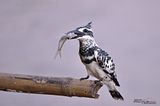
After I've been sitting in a hide for several hours, I went out walking around the pond on the west of the area. Many egrets, mainly Little and 1 or 2 Intermediate, were feeding there. I waited in a hide for few minutes and came a male Pied Kingfisher (Ceryle rudis) landing on a dead tree in the middle of the pond. Other birds feeding there include Green Sandpiper (Tringa ochropus), Citrine/White Wagtail, Common Kingfisher, Barn Swallow, Common Sandpiper, Common Moorhen and surprisingly a Purple Swamphen (Porphyrio porphyrio).

A male Pied Kingfisher

An uncommon Green Sandpiper

A flock of egrets

A non-breeding Intermediate Egret

I went back into the hide, still wishing for the Chestnut-crowned Bush Warbler to come out. People saw it coming to the waterhole around 4pm, but we didn't succeed in seeing any. There were many birds trying to come down to the waterhole but were chased away by the bad rubythroat. Once the rubythroat was away, many little birds suddenly came down to the waterhole including the secretive Baikal Bush Warbler (Bradypterus davidi), Dusky Warbler and Oriental Reed Warbler (Acrocephalus orientalis). One Chestnut-capped Babbler (Timalia pileata) was trying to come down to the waterhole but it was too wary and flushed away because of the shutter sound. That night we camped at the parking area. There were sound of Lesser Whistling-Ducks and Spot-billed Duck coming to the pond at night but all flew out before dawn. Several Black-crowned Night-Herons were flying around and calling at night as well as the Collared Scops-Owl (Otus bakkamoena) and the Large-tailed Nightjar (Caprimulgus macrurus) which I saw one silhouetting at dusk.

Guess we've taught a bad habit to this Rubythroat.

A Dusky Warbler

A very beautiful yet super shy Chestnut-capped Babbler

A view from the blind to the waterhole inside the reedbed

I've had enough of this Rubythroat to last me a lifetime.

A secretive Baikal Bush Warbler taking bath, shame it was already too dark.

The same Dusky Warbler

And the Oriental Reed Warbler, not so common here in Nam Kham area.

Egrets roosting at dusk

And a beautiful sunset at the pond to finish off with.