Showing posts with label Fukuoka. Show all posts

Monday, January 30, 2012

Other Birds From Fukuoka

This will be the final post for my trip to Fukuoka during the year's end and new year vacation. I found Imazu a very nice place for birding, even though I couldn't get any photo of the Black-faced Spoonbill in close range. Apart from the c. 100 Falcated Ducks in the earlier post, there were tonnes of many other ducks staying at the river mouth. Most of them were Mallards and Chinese Spot-billed Ducks, but I also found interesting species like 1 male Baikal Teal and at least 5 Common Shelducks among the flocks as well. Northern Pintails and Eurasian Wigeons were also numerous, with some Red-breasted Mergansers, Northern Shovelers and Common Teals. I believe that if I had a telescope with me, I'd be able to pick out some more.
A view of Zuibaijigawa (瑞梅寺川) at Imazu

Chinese Spot-billed Ducks (left) and a male Baikal Teal (right)
A flock of Great Cormorants (Phalacrocorax carbo)
Two resting Common Shelducks (Tadorna tadorna)
A crappy record shot of a 1st-winter Saunders's Gull (Larus saundersi)
On my second visit to Imazu, I also spotted a first-winter Saunders's Gull (Larus saundersi) resting on a sandbar along with the ducks. It is another globally endangered species which occasionally spends its winter in Kyushu. I've seen quite many of them back in 2009 when I visited Ariake Sea in Saga Prefecture. On the right side of the river, there were patches of rice fields where a pair of Tundra Swans was spotted earlier in December. Unfortunately, I wasn't lucky enough to see them. There was a flock of about 10-15 Northern Lapwings (Vanellus vanellus) in the rice fields though. I've never been able to get close to this shy species. Below are my best attempts of getting their photos.

Northern Lapwings (Vanellus vanellus)
They liked to hide among the dried grass.
Eurasian Magpie (Pica pica japonica)
Non-breeding Dunlins (Calidris alpina)
Eurasian Magpies (Pica pica japonica) were occasionally found in people's garden and along the roads. However, they were not as easy to photograph as I thought. After all, I could only get one (relatively) decent shot of it standing on the grass while picking up the food. In one of the small canals that flows into Zuibaiji River, I found a flock of about 50 Dunlins (Calidris alpina) resting and chirping like little chicks. I've never heard their voices before, but they seemed to be especially vocal at the time that I found them. They later flew out and made a nice aerial show for a few minutes before landing on the opposite side of the canal.
Female Osprey (Pandion haliaetus) carrying quite a huge lunch
An adult Eastern Great Egret (Casmerodius modesta) with nice breeding plumes
A young female Common Shelduck (Tadorna tadorna)
Juvenile Black-crowned Night-Heron (Nycticorax nycticorax)

Non-breeding Dunlins (Calidris alpina)
From the little research that I made before going to Fukuoka, Tataragawa River (多々良川) seems to be another great place to see Black-faced Spoonbills at close rage. I went there by walking quite a distance from the Kaizuka Station and asked local people about the area where the spoonbills are normally seen. I could finally find the place where the spoonbills are said to come and roost, but there was no spoonbill in sight. I waited until it was almost completely dark despite the biting cold wind and rain, but still no spoonbill came to the roosting site. Finally I had to leave for a warmer place and go back to the city without any photo of the spoonbill. To end this long post, below is a video of Dunlins that I took while waiting for the spoonbills at Tataragawa. I certainly need to pay a second visit to Fukuoka!

Ducks in Ohori Park

January 1st in Fukuoka was overcast with constant showers. I went to a park called Ohori Park (大濠公園) which is located not very far from Tenjin Station. It is a big park with a large pond inside. Despite the rain, I was quite satisfied with the photos of ducks that I got during my brief visit. There were lots of Common Pochards (Aythya ferina) staying in the pond with a some 20 Tufted Ducks (Aythya fuligula). Some of them were really tame and even seemed to be asking for food. However, it seemed like the park doesn't encourage people to feed these ducks. There were signs telling what will be the negative impacts if the ducks are fed (for example, they will become so fat that they cannot walk!).
Part of the Ohori Park (大濠公園)

Male Common Pochard (Aythya ferina)
Since I've never got any decent shot of both Common Pochard and Tufted Duck, I enjoyed taking photos of them up close despite the rain. I think there were approximately 100 Common Pochards in the pond. Most of them were staying in the middle of the pond though, so I mainly focused on the ones that came to ask for food. It was interesting to see that most of them were males. I just realised once I got back to the hotel that I took very few photos of the females and they were not nearly as good as the males'.

Female Common Pochard (Aythya ferina)

Male Tufted Duck (Aythya fuligula)
There were much fewer Tufted Ducks in the pond but most of them were even more approachable than the pochards. Again, most of the were males with only a few female birds. I didn't even get any decent shot of the females. All of the them seemed to be pretty lazy and slept throughout most of the time, except for the ones that came begging for food. Because the light was really bad and it's really difficult to get the correct exposure, I decided to use flash which, as a result, helped bring up the feather details both in the shadow and highlight parts.

Great Cormorant (Phalacrocorax carbo)
There were also many Great Cormorant (Phalacrocorax carbo) staying in the pond as well. There was a large tree in the middle of the pond and it was all covered with cormorants' droppings. It was quite shocking for me, as I first thought that it was some kind of lichen. Other birds found in the park included a pair of Gadwalls, some Eurasian Wigeons, lots and lots of Black-headed Gulls and Mallards.

Wednesday, January 25, 2012

Falcated Ducks

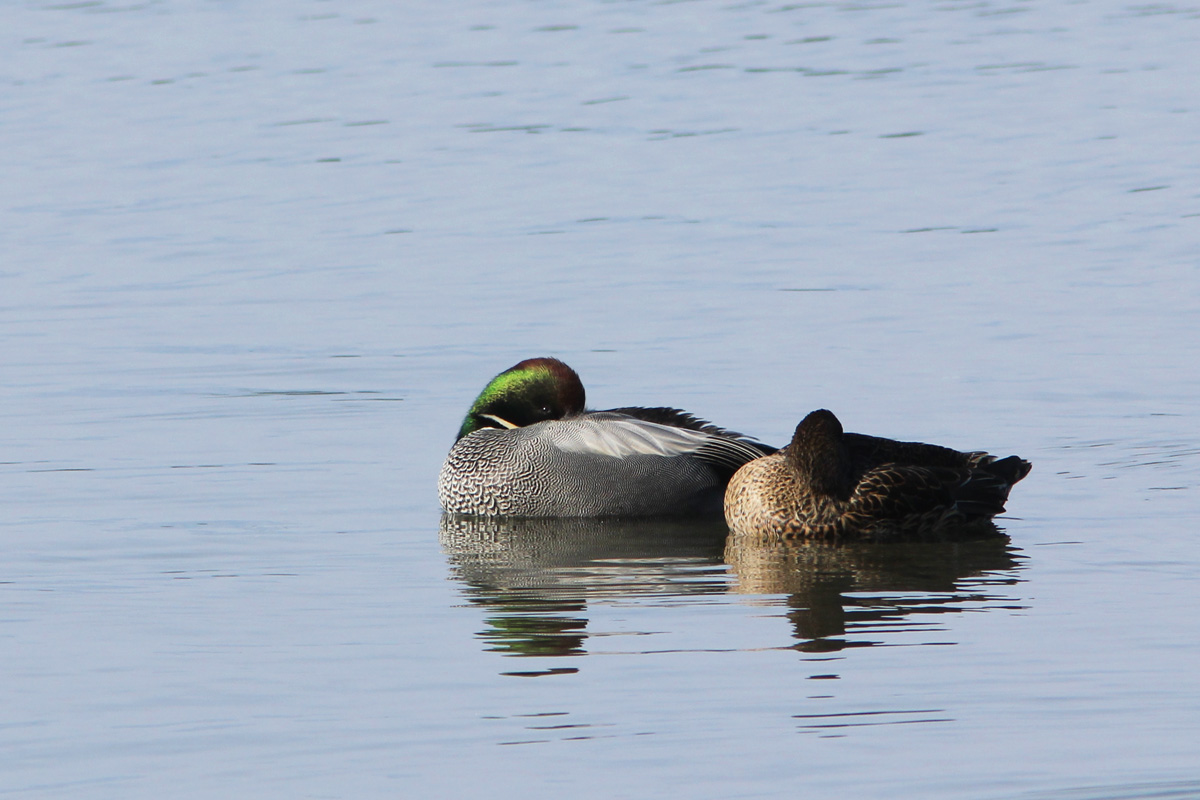
On my first day of visiting Imazu in Fukuoka Prefecture, I was really pleased to find that there was a good number of Falcated Ducks (Anas falcata) staying at the river mouth. This beautiful species of duck is one of the species that I've been yearning to photograph the most in Japan. It is a rare vagrant in Thailand and I have only seen a few females there. In Japan, I've seen them several times before in Kitsuki, Oita and Ono River, but never got a chance to get any good photos of them. Furuso-san has even found a male and a few females in Beppu. This time at Imazu, a flock of them was found sleeping just behind the sea wall. I could take photos of them quite easily from behind the wall. I just love the glossy head feathers of the male birds!

Male and female Falcated Ducks (Anas falcata)


Some more shots of the same group of birds
The birds flushed up as an old man came walking along the sea wall
The birds flew out into the middle of the river and stayed there for a while. They even began to perform their courtship display. The male birds became so excited with their heads held high, crests fluffed up and cocked up tails. They swam around the female, gave out their weird whistling call followed by a series of springing its body up and down. I took several videos of them doing the courtship display. One of the videos can be seen below. I was surprised to find that female birds also performed the dance ritual. I've never seen a female duck performing courtship display before. I think this is pretty weird.

Falcated Ducks sleeping and stretching

Male and female birds performing courtship display

Male birds demonstrating the courtship ritual
This group is part of the total of approximately 100 individuals
I waited for the birds to move closer to the sea wall, and they did. Even though they were not that tame or confiding, they came close enough for me to get some decent shots with my short lens. I just love how the glossy green and purple shades of the drakes' head feathers change rapidly according to the angle. It reminds me of male sunbirds or hummingbirds. I had a nice time taking photos of them as they slowly passed by in front of me. Even though they seemed to be sticking around in the same area behind the sea wall, I chose to move on since I was still on the search of spoonbills. If I had known that I wouldn't be able to get photo of the Black-faced Spoonbills up close, I would have chosen to stay a little longer with these gorgeous ducks.

Love the colour shifting head feathers of the drakes!