Showing posts with label Dunlin. Show all posts

Monday, January 30, 2012

Other Birds From Fukuoka

This will be the final post for my trip to Fukuoka during the year's end and new year vacation. I found Imazu a very nice place for birding, even though I couldn't get any photo of the Black-faced Spoonbill in close range. Apart from the c. 100 Falcated Ducks in the earlier post, there were tonnes of many other ducks staying at the river mouth. Most of them were Mallards and Chinese Spot-billed Ducks, but I also found interesting species like 1 male Baikal Teal and at least 5 Common Shelducks among the flocks as well. Northern Pintails and Eurasian Wigeons were also numerous, with some Red-breasted Mergansers, Northern Shovelers and Common Teals. I believe that if I had a telescope with me, I'd be able to pick out some more.
A view of Zuibaijigawa (瑞梅寺川) at Imazu

Chinese Spot-billed Ducks (left) and a male Baikal Teal (right)
A flock of Great Cormorants (Phalacrocorax carbo)
Two resting Common Shelducks (Tadorna tadorna)
A crappy record shot of a 1st-winter Saunders's Gull (Larus saundersi)
On my second visit to Imazu, I also spotted a first-winter Saunders's Gull (Larus saundersi) resting on a sandbar along with the ducks. It is another globally endangered species which occasionally spends its winter in Kyushu. I've seen quite many of them back in 2009 when I visited Ariake Sea in Saga Prefecture. On the right side of the river, there were patches of rice fields where a pair of Tundra Swans was spotted earlier in December. Unfortunately, I wasn't lucky enough to see them. There was a flock of about 10-15 Northern Lapwings (Vanellus vanellus) in the rice fields though. I've never been able to get close to this shy species. Below are my best attempts of getting their photos.

Northern Lapwings (Vanellus vanellus)
They liked to hide among the dried grass.
Eurasian Magpie (Pica pica japonica)
Non-breeding Dunlins (Calidris alpina)
Eurasian Magpies (Pica pica japonica) were occasionally found in people's garden and along the roads. However, they were not as easy to photograph as I thought. After all, I could only get one (relatively) decent shot of it standing on the grass while picking up the food. In one of the small canals that flows into Zuibaiji River, I found a flock of about 50 Dunlins (Calidris alpina) resting and chirping like little chicks. I've never heard their voices before, but they seemed to be especially vocal at the time that I found them. They later flew out and made a nice aerial show for a few minutes before landing on the opposite side of the canal.
Female Osprey (Pandion haliaetus) carrying quite a huge lunch
An adult Eastern Great Egret (Casmerodius modesta) with nice breeding plumes
A young female Common Shelduck (Tadorna tadorna)
Juvenile Black-crowned Night-Heron (Nycticorax nycticorax)

Non-breeding Dunlins (Calidris alpina)
From the little research that I made before going to Fukuoka, Tataragawa River (多々良川) seems to be another great place to see Black-faced Spoonbills at close rage. I went there by walking quite a distance from the Kaizuka Station and asked local people about the area where the spoonbills are normally seen. I could finally find the place where the spoonbills are said to come and roost, but there was no spoonbill in sight. I waited until it was almost completely dark despite the biting cold wind and rain, but still no spoonbill came to the roosting site. Finally I had to leave for a warmer place and go back to the city without any photo of the spoonbill. To end this long post, below is a video of Dunlins that I took while waiting for the spoonbills at Tataragawa. I certainly need to pay a second visit to Fukuoka!

Monday, May 3, 2010

Another New

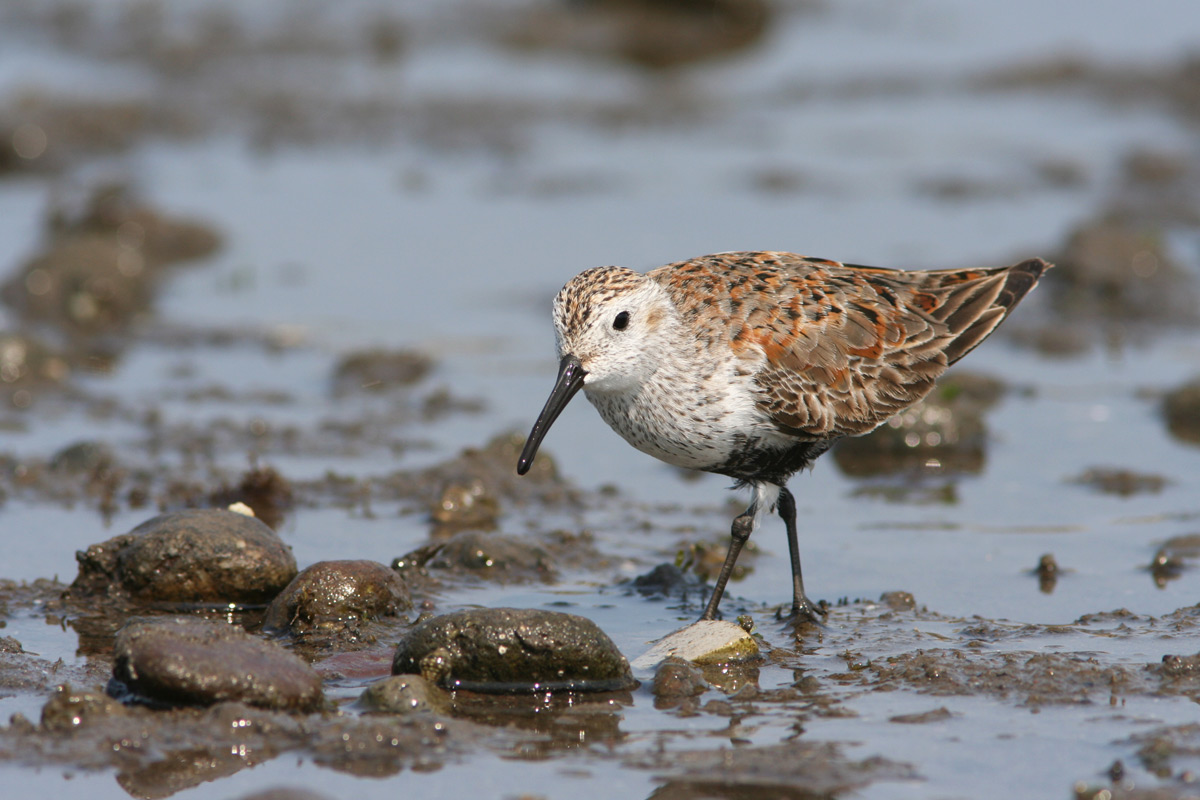
I got another new bird for my Beppu list yesterday at Rokushou-en. It was a Dunlin. Though it's a very common bird in Japan and I have seen lots of them in Saga, which is just few hundreds kilometres away from Beppu, it's the first time for me to see the species here. The bird was resting with its beak hiding in its back when I first saw it, but it later started to feed when I tried to approach.
Anyway, it was tame and cute in its breeding plumage. I have no idea what happened to its left foot though. There were some plastic-like objects attaching to its toes which made it a little bit more uncomfortable to walk.

Here you can see those suspicious objects on its toes quite well.

Somehow I think that I should let you all see the image just as how it really is, so I didn't crop any of the photos above and I think I'll continue doing it this way for the future entries if possible. These images are only resized and slightly brightened.

Wednesday, December 30, 2009

Shorebird Watch at Ariake Sea III

It's the last day for me here in Saga, and I decided to enjoy the hotel's breakfast at 7 instead of hurrying to the mudflat. It was very dark and grey outside and it seemed like it's going to rain. I got off from Saga Eki around 8.15 and arrived around 8.45. Today I was able to borrow a bicycle from an old bicycle shop near the Sumiyoshi bus stop in 500 yen so did not have to suffer a 6 km walk anymore. With a bicycle, I was able to arrive the mudflat in no more than 30 minutes, while it took me like hour and a half on foot. The tide was extremely low, just like the morning before, and there were not so many birds around so I rode to the other side of the land. I crossed a bridge to the other side of main river than leads to the sea and found 2 large flocks of Rook (Corvus frugilegus pastinator) feeding in the fields along with a huge flock of Eurasian Tree Sparrows.
A large flock of eastern Rook

Nothing much around actually, 2 Hen Harriers, a female and a juvenile, flushed up from a reed bed and Siberian Meadow Buntings and other common stuffs. I went back to the mudflat and decided to sit somewhere and wait for the waders to come closer since the tide was starting to rise. About half an hour later, I got so many Grey Plover (Pluvialis squatarola) and Dunlin shots. The plovers became surprisingly tame and came walking around all over the place. I was a bit surprised too to see so many Grey Plovers together like this. I've never seen them gathering in large flock before. But what attracted my attention most was the Eurasian Curlew (Numenius arquata), which seemed to be much more wary than the plovers. It didn't came any closer than 20 or 30 meters. There were many of them feeding around along with the plover. I tried to see if there's Eastern Curlew mixing in the flock or not but didn't find any.

A female Common Shelduck

The molt of the Grey Plovers are actually very interesting. I noticed that there were no, at least very few, adult bird. Most of the birds are either first-winter bird or juvenile. The first-winter birds are interesting to look at. Their worn rusty juvenile feathers are mixed with clean, clear-cut, new adult feathers, like the bird above. The new whitish feathers somehow make the bird looks cuter, kind of snowy.

A brownish juvenile bird

I wonder what were they eating?

The best I could get from the Eurasian Curlew. The bird below should be a juvenile judging from its distinctly shorter bill.

Then I spotted a small group of spoonbill resting far at the water edge. I sat and wait, constantly checked if the birds have moved or not, and finally the birds began to walk closer to the mudflat. I suddenly moved to the other corner of the walkway and sat there waiting for them to come closer but they just stopped there and began to sleep again. I finally found that there were 5 Black-faced Spoonbills and surprisingly 1 Eurasian Spoonbill (Platalea leucorodia). The bird was a non-breeding adult. It looks slightly larger than the Black-faced. I guess that's why Black-faced Spoonbill's scientific name is P.minor.

The Eurasian Spoonbill(left) is slightly larger than the Black-faced Spoonbill(right)

There were thousands of Northern Pintail

I like it when the ducks slowly floating by the flock of spoonbills.

The Eurasian Spoonbill has distinct yellow bill tip.

It slowly wandered around the area, but never came close.

The Northern Pintails mainly stayed away from where I was sitting

Also few waders around including these 2 Common Greenshank

And the abundant Dunlin

This juvenile Black-tailed Godwit was quite tame also.

So I had to leave to place because the rain was falling so hard and ended up soaking wet when I finally arrived at the bus stop just in time when the bus came. It was a nice trip and experience but I think I need another revisit in spring to get a better shot of the spoonbills which were all so far this time and to see the waders in full breeding plumage. I'm really looking forward to spring now.

Together they make a nice couple!