
Long-tailed Shrike (Lanius schach) is a common resident bird throughout Thailand but the two nominate races are the black-headed L.s.longicaudatus of central plain and L.s.tricolor of northern hills. The grey-headed L.s.schach seems to be first recorded just a few years ago during winter in Mae Hia, Chiang Mai. The individual showed up for 2-3 consecutive winters. I unexpectedly found this individual in the evening of September 19th. The bird was perching on a dead branch by Mae Taeng River. I had to observe it from the bridge which was quite far away from the bird. After I reported about it, another bird photographer from Chiang Rai also submitted a photograph showing a very beautiful male L.s.schach he photographed from Chiang Rai Airport earlier this year (23 February). The bird has much neater plumage with more black on forehead than the one I found here.


Long-tailed Shrike race Lanius schach schach


Apart from the L.s.schach above, there was also a juvenile L.s.tricolor calling on the other side of the river. L.s.tricolor is the nominate race of northern Thailand. It has distinct black head contrasting with white throat and rufous body. Its upper mantle is grey, unlike the nominate race of central Thailand, L.s.longicaudatus, which also has a much longer tail.
 Juvenile L.s.tricolor; note black head, grey upper mantle


Lots of egrets fly back to their roost in the upper stream of the Mae Taeng River (above) every evening. The two main species being Little Egret (left) and Cattle Egret (right) with a lesser number of Intermediate Egret, Black-crowned Night-Heron and Great Egret. I also photographed a young Brown Shrike eating a big cricket at Muang Chum on the same evening. There were far more many Brown Shrikes than Long-tailed Shrikes at the moment, but they were really difficult to get a decent photo. Lots of Chinese Pond-Herons have arrived as well, not to mention about the Wood Sandpiper.


Juvenile Brown Shrike eating a big cricket
 Non-breeding Chinese Pond-Heron

A pure flock of Wood Sandpiper


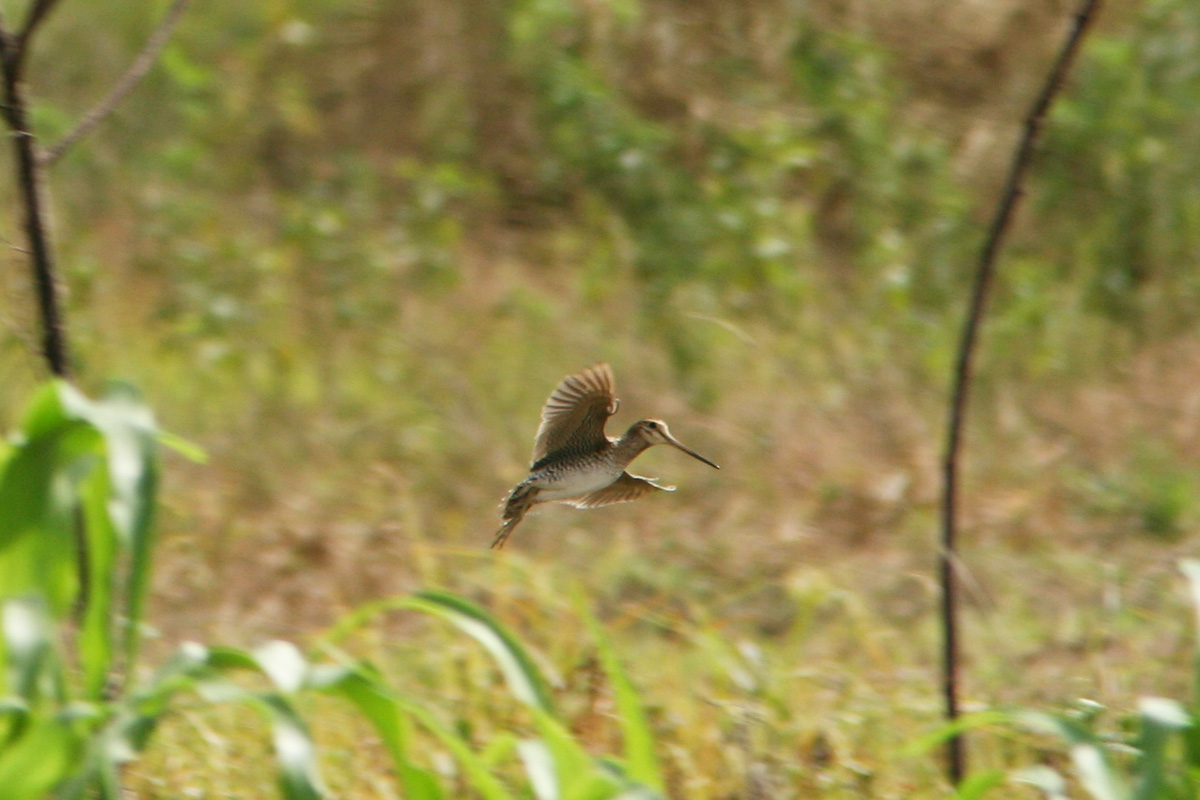


 The secretive Yellow-eyed Babbler


 September at Doi Angkang is my favorite! The morning sky is ultramarine, yet the thick fog at noon helps cool down the heat from sunlight. Rain falls in the evening and at night, brings fresh cool atmosphere to the early morning forests. Birds might not be as plenty as in winter, but they seem to be out continuously all day, and surely, seeing new migrants excites me every time I come here.


 A male Stripe-breasted Woodpecker on a fruiting Castanopsis tree.

 An individual with pale yellowish iris
 A Grey Treepie singing on a castanopsis tree


