
 I still have some more photos from my new year vacation in Thailand that haven't been put it into this blog. These photos are from a one-day trip to Doi Angkang with my father. The weather was fine but temperature was not as low as I thought. Most people had left the mountain since the holiday was already over. Not so many birds actually, but I did managed to get some nice shots of my all time favorite bird of Doi Angkang, the Crested Finchbill (Spizixos canifrons), and the commoner yet difficult to get good pics, Brown-breasted Bulbul (Pycnonotus xanthorrhous).


 Brown-breasted Bulbuls feeding on a fruiting tree
The birds were enjoying these yellowish fruits on the fruiting tree just on the roadside. The Brown-breasted was the most numerous with 2 Crested Finchbills, several Red-whiskered and Flavescent and a Sooty-headed Bulbul. I also found a pair of Mountain Bamboo-Partridge (Bambusicola fytchii) nearby but wasn't able to capture their photo.


 I was so happy to photograph these two Crested Finchbills closely.
 Then came a Sooty-headed Bulbul.


 I was so happy to photograph these two Crested Finchbills closely.
 Then came a Sooty-headed Bulbul.
Along the road were countless blossoming Pink Cassia attracting lots of Chestnut-flanked, Japanese and Oriental White-eye. I spent few minutes chasing a male Orange-bellied Leafbird (Chloropsis hardwickii) which came to feed on the cassia's nectar. I was super surprised to witness the bird mimicing the call of the Oriental Magpie Robin and Sooty-headed Bulbul. It's the first time for me to know that this leafbird can also mock other birds' voices. Before going back, I stopped at the fruiting tree again to see if there's any visitors and finally got a very shy White-browed Laughingthrush (Garrulax sannio), a bird once so common but rarely seen nowadays.

 A male Orange-bellied Leafbird
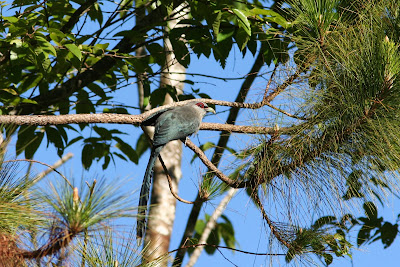 A secretive Green-billed Malkoha
 A male Grey Bushchat in its full breeding plumage
 And the very wary White-browed Laughingthrush


 And some sceneric shots to finish off with.

 A male Orange-bellied Leafbird
 A secretive Green-billed Malkoha
 A male Grey Bushchat in its full breeding plumage
 And the very wary White-browed Laughingthrush

 And some sceneric shots to finish off with.


 The secretive Yellow-eyed Babbler


 September at Doi Angkang is my favorite! The morning sky is ultramarine, yet the thick fog at noon helps cool down the heat from sunlight. Rain falls in the evening and at night, brings fresh cool atmosphere to the early morning forests. Birds might not be as plenty as in winter, but they seem to be out continuously all day, and surely, seeing new migrants excites me every time I come here.


 A male Stripe-breasted Woodpecker on a fruiting Castanopsis tree.

 An individual with pale yellowish iris
 A Grey Treepie singing on a castanopsis tree


