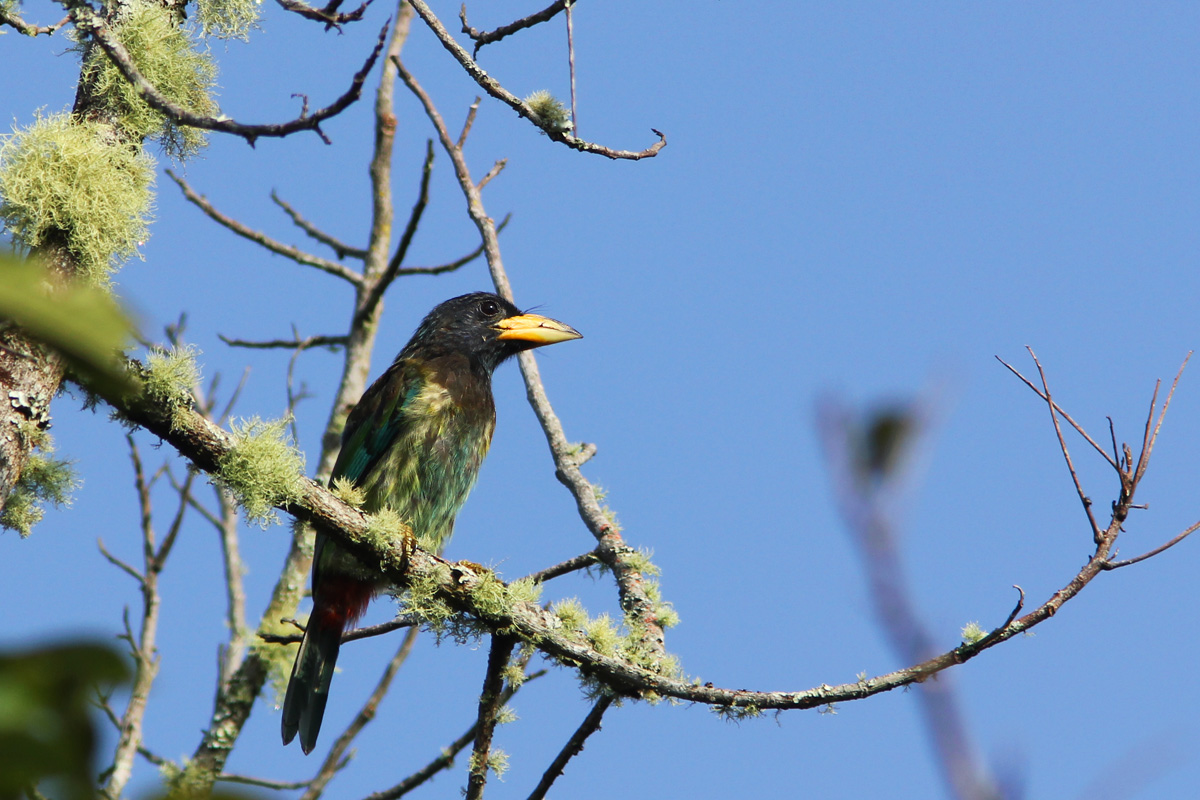
It was a cloudy early morning as me and my dad were going up hill heading to Doi Inthanon with our birding friend, Mam, sitting in the back. We made a stop at the second checkpoint and were surprised to find 4 more birding colleagues having coffee and breakfast in the back of their cars. We greeted and slowly started our birding around the checkpoint. There were not so many birds as there were very few moths around the checkpoint unlike how it used to be in the past, but we enjoyed killing time by talking and following some common birds. There was a pair of Flavescent Bulbuls (Pycnonotus flavescens vividus) perching in the hill near the checkpoint as usual. After a while, a small flock of Spectacled Barwings (Actinodura ramsayi) also came up to dry themselves on the same perch.


Spectacled Barwing (Actinodura ramsayi)
 Flavescent Bulbuls (Pycnonotus flavescens vividus)
 Male Short-billed Minivet (Pericrocotus brevirostris neglectus)
 And the equally colourful female
I spent a lot of time trying to get a decent shot of the Mountain Tailorbird you see in the earlier post, but I still couldn't get the shot that I wanted. There were many swifts flying above our head in the morning. After roughly scanning through all of them, I identified the migratory Apus pacificus pacificus race of the Fork-tailed Swift, the much smaller Himalayan Swiftlets, the House Swifts and the migratory Asian House-Martins. Unfortunately all of them were flying too high up in the sky and it was also too cloudy, not a good condition for BIF shots, so I concentrated on birding along the road. There was a pair of the striking Short-billed Minivets (Pericrocotus brevirostris neglectus) coming down to the lower branches on the roadside. It is never easy for me to get a good photo of the minivets, as they normally stay up in the canopy, so I was very happy to finally get some good shots of them.
 Dark-sided Flycatcher (Muscicapa sibirica rothschildi)


Sunbathing White-throated Fantail (Rhipidura albicollis celsa)


A Crested Goshawk (Accipiter trivirgatus indicus) doing courtship display
 You can see its fluffy undertail feathers as one of the courtship features.
I expected to see some migrants and was happy to find 2 Dark-sided Flycatchers (Muscicapa sibirica rothschildi) staying close to each other. Unfortunately both of them were occupying a very high perch, so I couldn't get any decent shot of them. Instead, I got quite a nice birdscaping shot of it. Other birds we found along the way include a flock of Grey-cheeked Fulvettas, White-throated Fantails, Davison's (White-tailed) Leaf-Warblers and a Crested Goshawk (Accipiter trivirgatus indicus) perching in the distance performing a courtship display. We assumed that there must be another bird perching somewhere behind the tree.
My dad later came and told us that he found a big flock of Doi Inthanon's star bird, the Green Cochoa (Cochoa viridis), on the side of the road to Mae Jam. He also saw a male Red-headed Trogon and several Slaty-bellied Tesias as well. He always the one who finds the good birds it seems. So we went there as found at least 4 Green Cochoas perching and flying deep in the forest on the roadside. These birds are so difficult to find because they sit very still among the leaves and rarely come out to the open. I assumed that it was a family group, as I only saw 1 adult male bird but several immatures. Immature birds have white stripes on the sides of the throat with brownish scales. I even luckily came across a very young juvenile bird sitting on a low branch just a few metres from the road on my back to the checkpoint. It turned out that its right wing was broken. There's a very small chance that it will be able to survive at this very young age, but I really hope it will.


Juvenile Green Cochoa (Cochoa viridis) with a broken wing
 An older immature bird
 Pallas's Squirrel (Callosciurus erythraeus)
 We stayed around the checkpoint until almost noon, then we headed up to Kew Mae Phan to have lunch at the restaurant in front of the entrance. In the back of the restaurant, we even found a first-winter Ferruginous Flycatcher (Muscicapa ferruginea), a species I haven't seen for a long time. After our meal, we went up to the highest summit to photograph some common species as well as the LBJs in the earlier post. Birds at the summit are extremely tame, this time especially the Silver-eared Laughingthrushes (Garrulax melanostigma ), which were hopping everywhere inside the coffee shop. They even stole some sugar from the box! Other Doi Inthanon's star birds like the endemic subspecies Aethopyga nipalensis ankanensis of the Green-tailed Sunbird, the Bar-throated Minla, the Ashy-throated Warbler and the Dark-backed Sibia were also showing well. I even came across a quite approachable male Mrs Gould's Sunbird (Aethopyga gouldiae dabryii) which was feeding on small flowers by the roadside. It's such a striking little bird that I can never get tired of watching.


Mrs Gould's Sunbird (Aethopyga gouldiae dabryii)
 It's never easy to get the glossy feathers.
 Another shot of the Pallas's Squirrel
 Bar-throated Minla (Chrysominla strigula castanicauda)
 Dark-backed Sibia (Heterophasia melanoleuca)


Silver-eared Laughingthrush (Trochalopteron melanostigma)