We finally got some nice weather here in northern Thailand after a long series of rains and storms. Many parts of the country are now suffering from serious floods. Luckily, it was not raining on September 3 when I went to Doi Angkang with my dad for the first time for this school vacation. Actually we were terrified by heavy dark clouds around Chiang Dao city, completely covering the 3rd highest mountain of Thailand, Doi Chiang Dao. But as soon as we reached the foothill of Ban Arunothai heading towards Doi Angkang, the sky became surprisingly clear and we were finally hit by the first sun light as we drove up the Pha Daeng hill.
 The first view of blue sky at Ban Pha Daeng


Male Shikra (Accipiter badius poliopsis)
The first bird that came out to welcome us was the above male Shikra (Accipiter badius poliopsis) at Ban Arunothai. It was perching quite low on an electrical wire on the roadside. I was surprised to find that it wasn't as shy as I expected it to be. It would constantly flew off a bit further but always landed on the same wire. However, the lighting condition was extremely poor, and it was impossible to get a crystal clear shot. The above photos were heavily processed through photoshop.
 Sunlight hitting a local plantation among the limestone
 White-browed Laughingthrush (Pterorhinus sannio comis)
Birds along the road were relatively numerous. We found several flocks of the locally fairly common White-browed Laughingthrushes (Pterorhinus sannio comis) along the way. The distribution of this species of laughingthrush in Thailand is very restricted. It can only be found on few high mountains on the north-westernmost part of the country. One of the flocks even came down to pick up dead insects on the road. Rainy season is the best time to see these local laughingthrushes. They mostly disappear during winter and dry season. Doi Angkang is definitely the best place in Thailand to see this species. Other birds we found along the road included several flocks of Striated Swallows, many large flocks of Barn Swallows, a couple of Common Hoopoes and Grey-headed Parakeets, a Yellow-eyed Babbler and a Brown Shrike.
 Striking landscape and brilliant weather at the army checkpoint
 Female Stripe-breasted Woodpecker (Dendrocopos atratus)


Male bird with an immature female Verditer Flycatcher (Eumyias thalassinus) perching in the background
 Male Oriental Magpie-Robin (Copsychus saularis)
As we arrived at the army checkpoint, I dropped off to snap some landscape shots before moving on as there were not so many birds around. We drove down the first hill after the army camp and came across a single Mountain Bamboo-Partridge (Bambusicola fytchii) perching in a small bush on the roadside. It then disappeared into thick vegetation. We decided to wait just in case it might come out again to the open roadside. As we were waiting inside the car, I heard a Collared Owlet (Glaucidium brodiei) calling from somewhere not very far from the road, so I began playing my mp3 file in my iPod. The bird responded so well, actually too well that it brought 2 more birds into the area. What happens when there are too many birds calling out for territory in the same area is that all of them would become too frustrated to come out to the open, so I ended up seeing no owlet at all. However, the calls of the owlets (including me) had actually brought in a hell of a bird wave.
 Grey Treepie (Dendrocitta formosae himalayana)
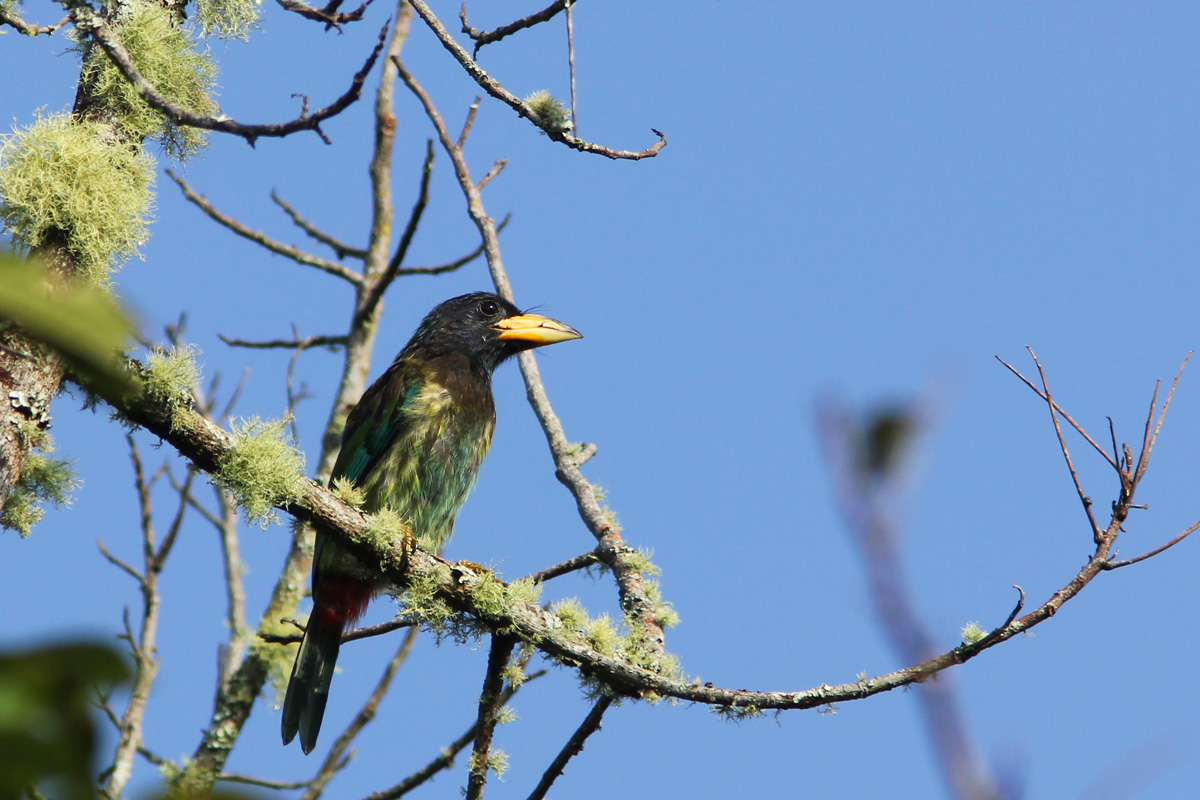


Great Barbet (Megalaima virens clamator)
 Thick-billed Flowerpecker (Dicaeum agile pallescens); Note the white tail tips
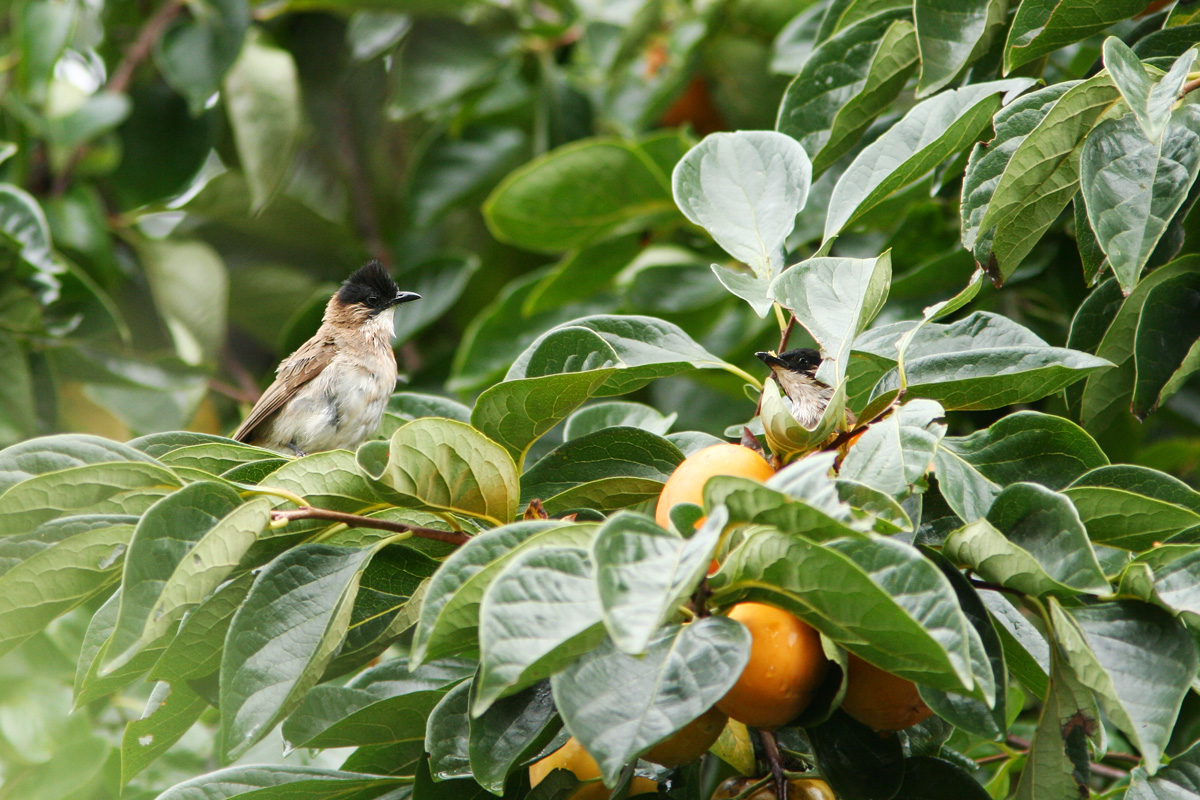
It is widely known among birders in the countries with Collared Owlets that if you play the call of the owlet, many small birds would hyper-actively come to flock around you. The reason behind this phenomenon is that because the Collared Owlet mainly preys on small birds, these birds finally learned to flock up and harass the owlet as a team. We call this act of small birds harassing a predator in flock "mobbing". So as I was playing my Collared Owlet call with 3 more real owlets calling outside in the forest, a large number of birds began to gather above our car. These included a Verditer Flycatcher family, a pair of male and female Stripe-breasted Woodpeckers, a flock of noisy Grey Treepies, a pair of Great Barbets, several Bronzed and Ashy Drongos, a flock of Common Ioras and Velvet-fronted Nuthatches, a Lesser Yellownape, Black Bulbuls and a Thick-billed Flowerpecker. It was the first time for me to see and photograph the canopy-dwelling Great Barbets in an acceptable range and good light. I didn't know that they would be interested in Collared Owlets.
 White-browed Laughingthrush (Pterorhinus sannio comis)
 Another shot of the same species
 Crested Finchbill (Spizixos canifrons ingrami) sunbathing


Juvenile Black-breasted Thrush (Turdus dissimilis)
As we were driving through Ban Luang village, I asked my father to stop and photographed the resident race S.m.przewalskii of Eastern Stonechat that can only be found at Doi Angkang. However, my dad spotted a strange looking bird with spots on its underparts perching on the rock about 50 metres away from the stonechat. After a brief struggling, I finally spotted the bird and was extremely happy to see that it was a juvenile Black-breasted Thrush (Turdus dissimilis), a species once thought to be winter visitor in this country until last year when my friends and I discovered a nest at the very same area at Ban Luang village. There seemed to be at least 2 juveniles staying in the area. One was shyer and only stayed in the trees high up on the hill, while another one (the one in the photos) was much more approachable as it came down to feed on wild berries and earthworms along the water channel on the roadside. Photos and information about the first nesting record of this species at Doi Angkang can be view here.
 "Chocolate" Eurasian Tree-Sparrow (Passer montanus malaccensis)
 Female Oriental Magpie-Robin (Copsychus saularis)
 Brown-breasted Bulbul (Pycnonotus xanthorrhous)


Male (left) and female (right) Mrs Gould's Sunbird (Aethopyga gouldiae dabryii)
We had lunch at the Royal Project's restaurant. Normally, there would be large flocks of Red-whiskered Bulbuls during this time of year, but strangely we only saw a few. Hopefully, they were not captured and sold, since the demand in the market is very high for this species. There were several Eurasian Tree-Sparrows (Passer montanus malaccensis) around the restaurant though. I'm always puzzled about the colour of these tree sparrows at the Royal Project. They are so brown. The adult birds are even browner than the juvenile bird in the photo shown above. I call these tree sparrows "chocolate" tree sparrows. I have no idea if it is because of a different subspecies or food or environment. After lunch, we drove through Ban Luang village and stopped at a garbage dump with an old stable for horses. There was nothing much except a shy Bay Woodpecker, several resident Eastern Stonechats, many singing Brown-breasted Bulbuls and a pair of Mrs Gould's Sunbirds (Aethopyga gouldiae dabryii). This species of sunbird is another bird that is suspected to be/or have become a resident bird of Thailand. Until now it is known to be a winter visitor, but there are many records that are so early that they're pretty unusual for a winter migrant. We just have to wait until someone finds a proof that it actually breeds in this country.