Showing posts with label Grey Wagtail. Show all posts

Tuesday, December 21, 2010

Life In The River

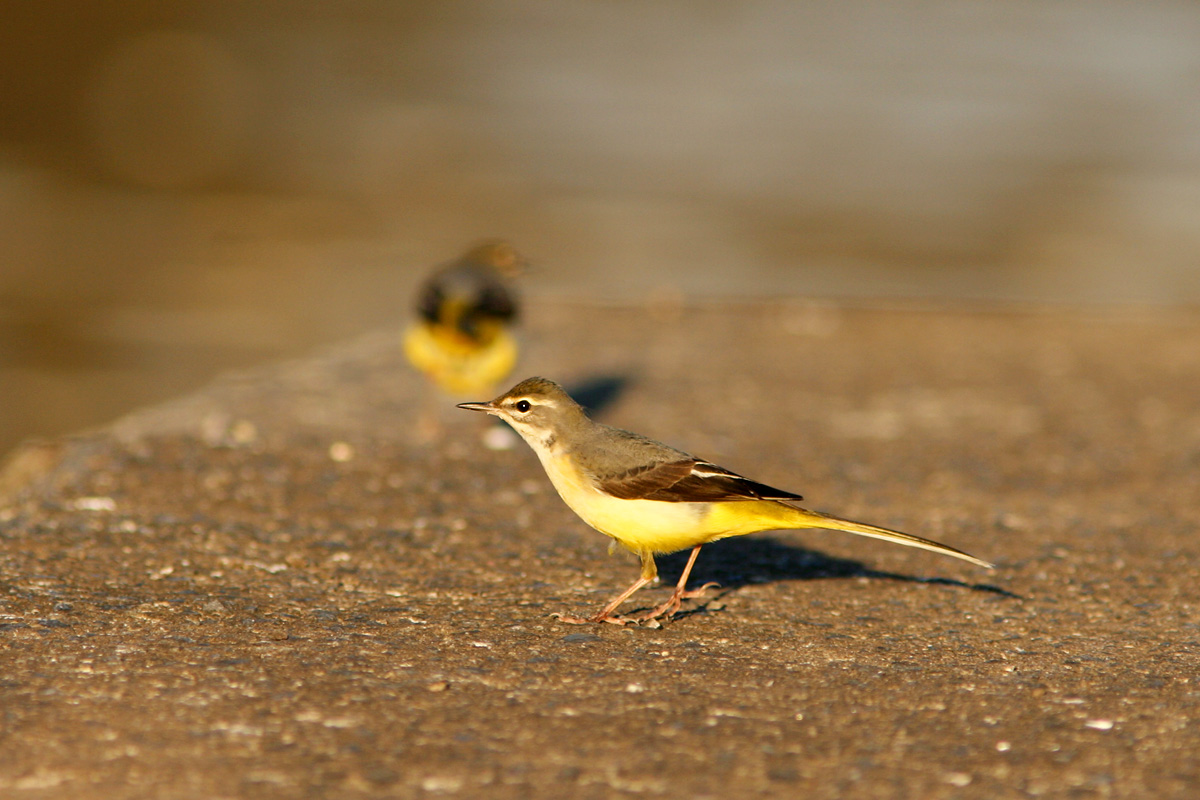
Still a post with old photos from the last few days of November. After finishing the siskins in Beppu Park, I always walked down to Oyukaeri River in Asami 3 Chou-me to photograph the Brown Dipper. Some day the dipper was so shy and I just couldn't get any slight shot of it, but for some, it became relatively much easier. At times when the dipper didn't come out easily for me to get photos, I killed my time by shooting other common objects like wagtails that were feeding in the same river. There were 3 species of wagtails, Japanese, Grey and White. The number of the Japanese Wagtail seemed to be the highest, then Grey and White Wagtail. However, the tamest was the Grey Wagtail which has yellow feathers up to its throat. If often came walking around 2 or 3 metres away in front of me. I really wish the dipper were as tame as this.

Non-breeding Grey Wagtail (Motacilla cinerea)

The most interesting one was this Motacilla alba alboides, a subspecies of White Wagtail (Motacilla alba) which is not so common here in Japan. Although I have seen this subspecies several times in Thailand during winter, I've never seen it in Japan before. The nominate race of White Wagtail in Japan is the subspecies M.a.lugens which has much more white on the head and neck. M.a.alboides interestingly looks much more like the local Japanese Wagtail (M. grandis).

Brown Dipper (Cinclus pallasii)
And of course, there are other birds other than the wagtails. A female Common Kingfisher was another regular visitor to the place where I waited for the dipper. Although I couldn't get any closer than 20 metres or so, I was quite satisfied with the birdscape shot I've got. A few Common Sandpipers were also walking along the river, as well as a small flock of Common Teals on the upper stream. I finally got some shots of the Brown Dipper in good light and out in the open, but a shame it was a bit too far away. I think I'll continue working on the dipper again in spring cos it's gotten really difficult for me to sit motionlessly on the river bank waiting for this plain little brown bird for hours in freezing temperature.

Wednesday, November 3, 2010

Goose in the Rain

After first seeing the Tundra Bean Goose at Sekino-E on October 23, I revisit the place again on the following morning. Although the bird was still staying at the same place (and with the same Mallard), I didn't get any better photo because of the rain. It started to pour down as I was approaching the area and fell heavier as I was photographing the goose. Well, although the pics aren't looking any better than in the previous post, they somehow look a bit more artistic because of the rain.


Tundra Bean Goose (Anser fabalis serrirostris)

With the same male Mallard
A very poor flight shot just to prove that the bird is actually wild
While taking photos of the goose, several wagtails came walking very close to me. Too bad it was really dark and the speed shutter I got was very low. I tried my best and finally managed to get some acceptable shots of the Grey Wagtail which came closest. Japanese Wagtails were quite numerous and the number of White Wagtail seemed to start falling.

Non-breeding Grey Wagtail (Motacilla cinerea)

Sunday, October 24, 2010

Late Afternoon

Gotta be more active in publishing posts in order to keep up with the photos I took. These shots were all taken in and around the artificial river near my dorm several weeks ago. A few juvenile Grey-tailed Tattlers were still lingering around, though all of them have already gone by now. The White and Grey Wagtails were numerous. The White Wagtails were especially photogenic. Many of them showed yellowish wash on their faces indicating that they're juveniles.

Juvenile Grey-tailed Tattler
Note its pale fringes on upperwing coverts

Juvenile male White Wagtail (Motacilla alba lugens)

Non-breeding Grey Wagtails
Some more photos of the migrating starlings again. I finally found out that the flock came down to bath in the river before flying up to preen themselves on electrical wires nearby before flying out to the Beppu Tower, their actual roosting site. I didn't find any Red-billed Starling since that day, although I scanned through most of the main flocks. Photographing them at dusk was really difficult since the speed was really low and the photos also look really dark.