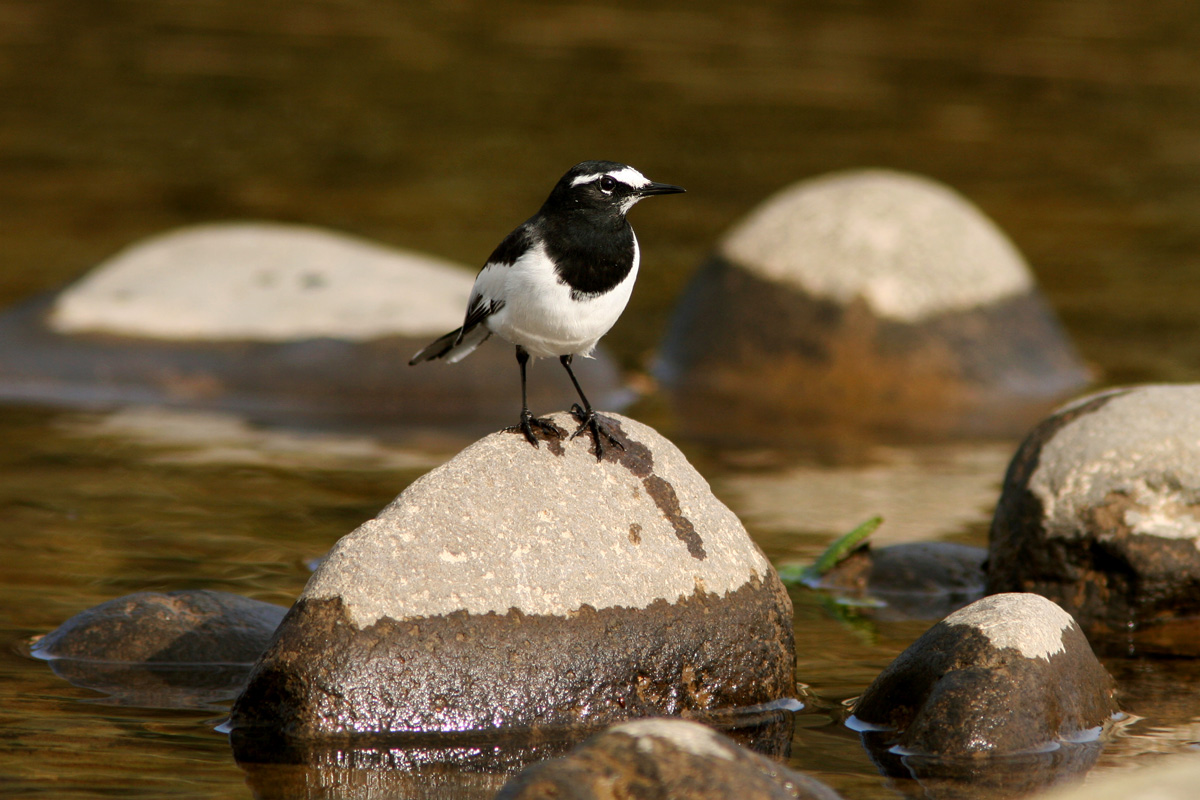
Late December excited me with the discovery of a male Scaly-sided Merganser (Mergus squamatus) at Ono River. On January 29, I went there to look for the bird but failed to see it. The bird proved to be nomadic. It disappeared from the first location where it was found and was later spotted many kilometres upstream several days later. I followed the news with the help from other birdwatchers in Oita but still couldn't manage to see it. I failed twice and felt so discouraged that I stopped following it. Last month, the bird was spotted again with a female! The pair was found staying in a lake up on the mountain in Yufu city. The place seems to be accessible only by private cars, so I had no chance to see them. Anyway, this post is all about the other birds that I found and photographed during my visits to Ono River.


Probably non-breeding male Long-billed Plover (Charadrius placidus)


Probably a female bird
Ono River (大野川) seemed to be a very good place to see Long-billed Plovers (Charadrius placidus). They were numerous along the rocky riverbanks in the area where I was looking for the merganser. Almost all of them were staying in pairs. I noticed that one of the birds in each pair would have more black on its face and breast band, and another one would have plainer face. I assumed that the darker one might be a male bird and another is a female. Even though they were numerous, it was really difficult to photograph them. They were shy and would normally fly away before I reached a certain range that is good enough for my lens. I finally found the trick that made me more successful in photographing these shy birds. I noticed that they would try to camouflage by lying low among the rocks when I walked with my back straight, but tended to fly away when I tried to approach by crawling towards them. This is quite opposite to most birds that feed on the ground, which tend to be less comfortable with any vertical matter than moves horizontally, i.e. human. So I tried walking indirectly towards them with my back straight and when I got to the acceptable distance, I would sit down and wait for the birds to rise up and move freely.


More individuals with blackish face and breast band


Another bird that I tried to photograph while I was waiting for the merganser was the Little Grebe (Tachybaptus ruficollis poggei). There were about 3-5 pairs staying in the same area. Like the Long-billed Plovers, they were numerous but clearly moved in pairs. With a photography hide, I could take some photos of them in a close range since they tended to favour shallow water near the banks. I also noticed that one of the individuals in each pair would be slightly darker than another one as well. The darker individual would have darker brown cap and upperparts. These darker individuals might as well be the male birds.


A non-breeding Little Grebe (Tachybaptus ruficollis poggei)
 A darker individual
 A non-breeding Little Egret (Egretta garzetta)


Black-eared Kite (Milvus lineatus)
Apart from the Long-billed Plovers and Little Grebes, there were not so many other birds in the river. I feel like even Oita River seems to be a much better place for general birding. Birds in Ono River seemed to be much more wary and less numerous. Other birds found on my 2 visits included a Eurasian Sparrowhawk, an Osprey, Black-eared Kites, Little and Great Egrets, distant Mandarin and Falcated Ducks, a female Common Merganser, Great Cormorants and lots of Common Teals. The transportation fee is quite expensive, so I don't think that I'll make another visit to look for the Scaly-sided Merganser again. Hopefully, I'll be able to see it someday in the future before it becomes even more endangered than it is now.