The best birding day of the trip was actually the second day when we went for a morning walk in the Km. 34.5 jeep track and a flock of uncommon Grey-breasted Parrotbills (Paradoxornis feae), a member of the babbler family, came passing by. The bird was formerly classified as a subspecies of Black-throated Parrotbill (Paradoxornis nipalensis) but now split according to Craig Robson's latest guide book. I've found this bird once near the summit and several times at Doi Lang and India. It's a tiny bird with bright orange plumage which can be spotted easily as they move rapidly in flocks through low vegetation. Too bad the birds were all too fast for me to get any decent shot and didn't come back though I've waited for almost half an hour.


Grey-breasted Parrotbills (Paradoxornis feae)


At the 2nd Checkpoint, several Yellow-cheeked Tits (Parus spilonotus) put on the show as usual. These birds, although being common and friendly to people, are always too cute to ignore. The one in the large photo is perching on a sign labeled "Doi Inthanon National Park"!
 A panoramic view of the forest of Doi Inthanon National Park
 Another uncommon bird that we found in the jeep track at Km. 34.5 was this secretive White-gorgeted Flycatcher (Ficedula monileger), which 2 individuals were found chasing each other and calling their alarm calls. The bird is especially easy to find here at Doi Inthanon than other places in Thailand. However, its plain brownish plumage and secretive behaviour make it not so easy to be spotted.


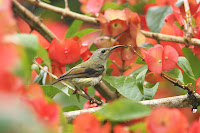


(Top) A juvenile male Black-throated Sunbird (Aethopyga saturata) (From left to right) 1-2. The same juvenile male Black-throated Sunbird 3. An adult Little Spiderhunter (Arachnothera longirostra) 4. A juvenile Little Spiderhunter


Adult Grey-breasted Prinia (Prinia hodgsonii) in breeding plumage


At Mr. Daeng's restaurant, we enjoyed watching many little birds that come and go around the restaurant area. There's a flowering Chinese Hat near the parking lot and a family of Little Spiderhunters, Black-throated Sunbirds and Grey-breasted Prinias came visiting the tree all days. Mr. Daeng told us that sometimes the Streaked Spiderhunter and Hill Prinia also visit the tree, but we didn't see both species during the stay.


On the second evening, I had nothing to do so I went to the park's camp ground to wait for the rare Black-tailed Crake (Porzana bicolor) which breeds in a small grassy swamp and often comes out to the lawn nearby. Many years ago, there was a pair which was so tame that it could be guaranteed that you wouldn't miss them. Bad luck came when too many birders visited the birds and attracted local attention. Several months after the birds became famous, one of the birds was shot by a group of local teenagers and the other bird didn't come out to the lawn again. Birders were angry and the park finally announced the area as a protected area for this bird and park rangers were set to monitor the area. After years of not even a single sight, the bird finally came out again and it has found a new mate, but both of them were very shy. Mr. Daeng began to feed them continuously and they've gradually come out more often from time to time, but never as often and obliging as its first appearance. Some people came and saw them easily, while many waited all day and couldn't even see a single sign. I think I can be categorised into the first group though. I've succeeded in photographing the bird in July 2007, when the pair brought out their two fledglings to the lawn. This time I could also photograph the bird at close range and out in the open, though only 1 bird came out. The trick is to put out some food and make a crumpling sound of plastic bags and be patient. When they hear the sound of plastic bags, they know that there's food for them. However, not everyone succeeded even when using the tricks, these birds can even be more tricky!
A panoramic view of the forest of Doi Inthanon National ParkAnother uncommon bird that we found in the jeep track at Km. 34.5 was this secretive White-gorgeted Flycatcher (Ficedula monileger), which 2 individuals were found chasing each other and calling their alarm calls. The bird is especially easy to find here at Doi Inthanon than other places in Thailand. However, its plain brownish plumage and secretive behaviour make it not so easy to be spotted.


Adult Grey-breasted Prinia (Prinia hodgsonii) in breeding plumage