Showing posts with label Mochigahama. Show all posts

Saturday, December 3, 2011

Kentish Plovers

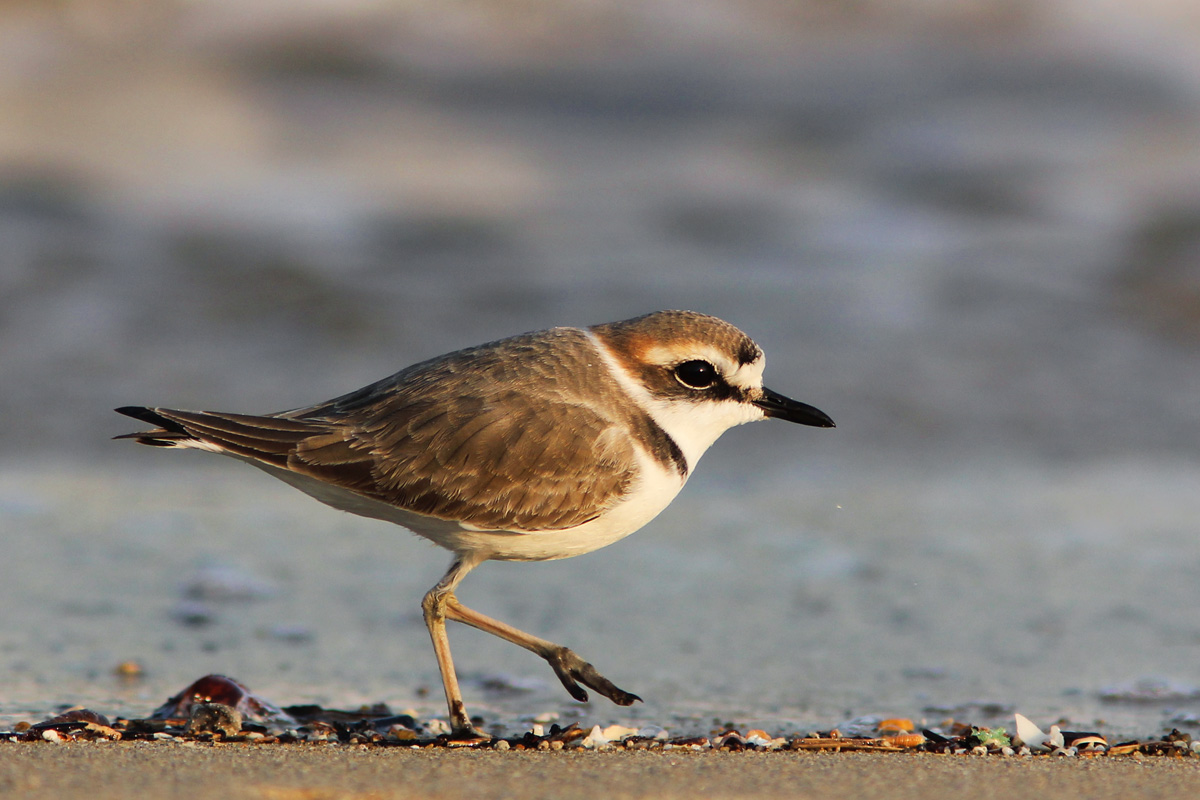
These photos of male Kentish Plovers (Charadrius alexandrinus nihonensis) were taken a while back during the last week of November. I heard the news from Furuso-san that there were 2 Kentish Plovers, a male and female, staying at the Mochigahama beach. I went there several days later and found 2 male birds instead. One was staying in the Kotsu Center side and another one around Mochigahama side. Both of them were quite obliging but the one near Kotsu Center was especially tame. I've never seen any Kentish Plover as tame as this one before. I took a few videos of it too and you can see how close I was able to approach it.

Male Kentish Plover (Charadrius alexandrinus nihonensis)

Here's the video of the tame one. It seems to be in an almost full breeding plumage. It's interesting how these plovers moult into breeding plumage so fast. The population that winters in Thailand and South-east Asia wouldn't have the same orange cap and black marks at this time of year. Male and female birds would normally be looking the same in the wintering grounds. Maybe it's because these plovers in Japan don't migrate? Some of them might migrate to eastern parts of SE Asia (like Borneo), but some might stay in Japan throughout the whole winter (like the ones in Beppu) and begin to mate earlier like other resident birds?

The race 'nihonensis' or 'eastern' Kentish Plover seems to be much paler than the nominate race 'alexandrinus' that winters in most parts of SE Asia. I've never seen any male bird in Beppu that has completely rufous crown in breeding plumage like ones that winter in Thailand. The legs are also much paler. Most of the birds that winter in Thailand look like this when they moult into full breeding plumage. Below are some more pictures of the same male bird taken a few days earlier exactly at the same spot.

The same male Kentish Plover (Charadrius alexandrinus nihonensis)
This photo was taken by the 18-55mm lens. I was about 5m from the bird.

The other bird I found that was staying on the Mochigahama side was still possessing more non-breeding feathers. Its black bands on the breast sides, face and forecrown were still not as dark and clear as the one near Kotsu Center. It was a little more skittish and didn't let me get as close as the other one. I was wondering about where did the female bird go. I've never seen a female bird at Mochigahama Beach before, but I've seen quite a lot at Sekinoe Beach, but all of them are so shy over there. It seems like I've had enough photos of the males. Now it's time for me to get some decent shots of the ladies.

Another male Kentish Plover (Charadrius alexandrinus nihonensis)

Thursday, July 28, 2011

Both Plovers

May 11, as I was observing a pair of a male and female Greater Painted-Snipes (Rostratula benghalensis) at Sekinoe, Furuso-san came by and showed me photos of a Kentish Plover chick she surprisingly found at Mochigahama beach the day before. I've never seen a plover chick before, so I was very excited and wanted to head to Mochigahama right away, but unfortunately it was already too dark. I had to wait until May 13, when I finally had enough free time to go and look for the plover chick. As soon as I arrived at the place where she found the chick, I suddenly heard a distinct whistling call. I looked around and finally spotted a male Kentish Plover (Charadrius alexandrinus nihonensis) standing still giving its call from the top of the rock. I knew right then that the chick must be somewhere near, but it's too difficult for me to find the chick by myself, so I stepped back and observed the adult bird. The adult kept calling for a short moment, then a tiny object came moving rapidly along the dirty rocks. Yes, it was the chick!

Male Kentish Plover (Charadrius alexandrinus nihonensis)
Kentish Plovers in Japan seem to be much paler than the ones I normally saw in Thailand. As suggested by Dave Bakewell in this post, the ones occur in Japan are the race C.a.nihonensis, while the ones in Thailand are the nominate 'alexandrinus' race. This male here is especially pale, almost as pale as the recently split White-faced or Swinhoe's Plover (Charadrius dealbatus), except for its distinct black lores. Its breastpatches are thin and short, and its eyestripes are faint. It looks almost like a combination between the male Kentish (C.a.alexandrinus) and Swinhoe's Plover in the photo taken in Thailand by Smith Sutibut below.
Photo by Smith Sutibut; Kentish Plover (left) and Swinhoe's Plover (right)

Male Kentish Plover
Here's the chick

Best attempt to camouflage. Not working? Then run!
After the chick finally showed up, it became very easy for me to take photos. The only thing I needed to concentrate on is the chick. I had to focus on it wherever it ran to, otherwise I would lose both the chick and the parent. The chick was extremely cute. When I got too close it would just stayed still as if it was dead. It always tried to run to the closest object that looked similar to its plumage, like stones or washed up seaweed. If I stepped back a little and sat still for a moment, it would slowly rose up and quickly ran off as fast as possible. It was entertaining for me to watch the adult running along with the chick looking for food along the beach. I always made sure that they were together before I left the place. Both of them have already left the beach now. I hope that they are doing well somewhere along the coastline of Beppu.

Male assuming breeding plumage Greater Sand Plover (Charadrius leschenaultii)


Apart from the cute pair of Kentish Plovers, Mochigahama beach also offered a nice male moulting into breeding plumage Greater Sand Plover (Charadrius leschenaultii). The bird was first found on the evening of May 13, and stayed for a few days later. It was a bit sad that the bird was still on its way moulting into breeding plumage. It'd be wonderful if it's already fully moulted. About a week before I found this bird, a pair of Lesser Sand Plovers was also found at Rokushou-en. One of the bird was also in its breeding plumage and it looked very beautiful. Another one was still in its non-breeding plumage though. I kinda regretted that I didn't check the Oita Birds website earlier. By the way, the Greater Sand Plover is a better find though, as it is much scarcer than the Lesser Sand here in Japan. Both of them are numerous in Thailand, but the chances to get close to them are very few.

Thursday, July 21, 2011

The Next Episode

A male Kentish Plover (Charadrius alexandrinus nihonensis) at Mochigahama Beach taken on May 14, 2011. One of the 3 species of plovers found on the same day. The other 2 were the resident Little Ringed Plovers and the moulting male Greater Sand Plover. Episodes about all these three plovers will be coming soon!