Showing posts with label Great Crested Grebe. Show all posts

Monday, February 6, 2012

Great Crested Grebe Influx

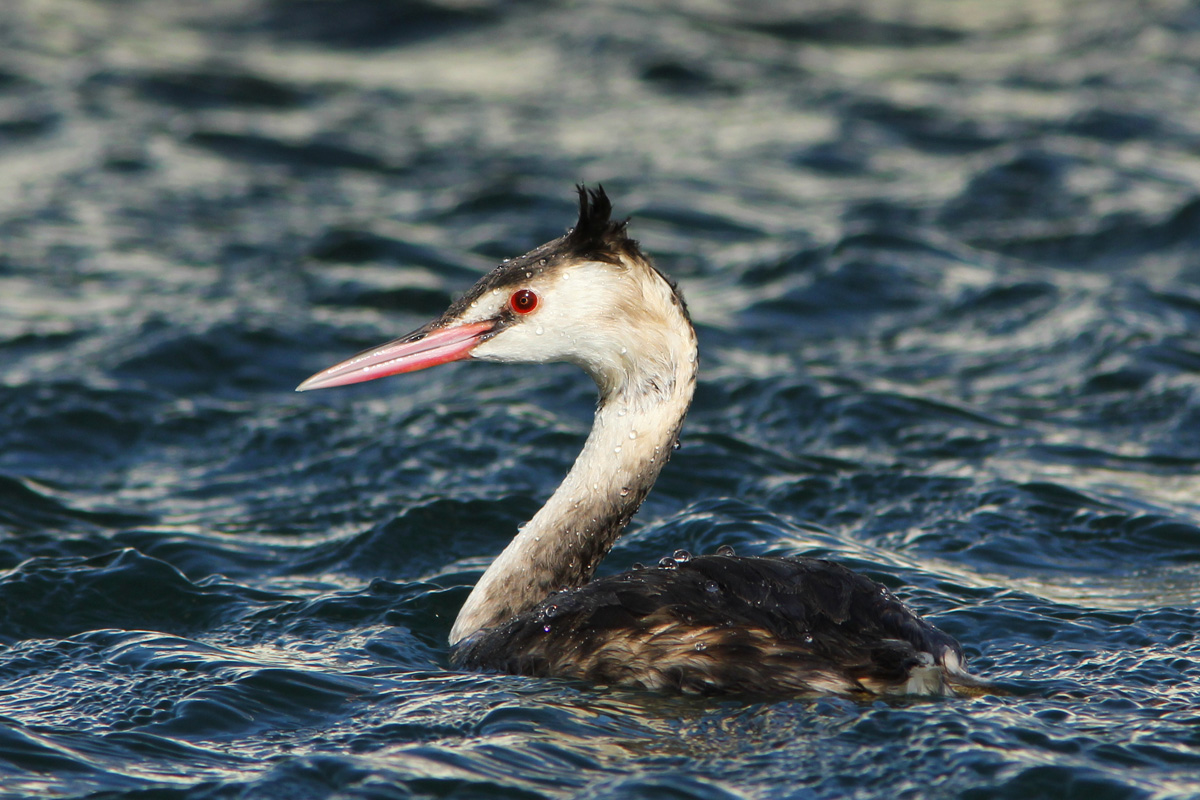
Few weeks ago, there was a Great Crested Grebe (Podiceps cristatus) influx around my dorm. I once counted 26 birds in one group and there were also many others scattering in the sea and small ports. Most of them didn't let me get close as usual, but I found 1 individual in a small port in Kyomachi that was obliging enough for me to get some decent shots at close range. Several days later, the number of the individuals in that port increased to the maximum of 7 birds. However, all of them has recently disappeared from the port after the weather has worsened. I just hope that they'd come back again and stay until they fully moult into their beautiful breeding plumage.

Great Crested Grebe (Podiceps cristatus) in non-breeding plumage


At first it was not easy to get close to the bird at all, since it kept staying in the middle of the port once it saw me. I sat and waited until the tide became lower and the bird seemed to become more interested in feeding along one of the shallow corners where it caught quite many small fish. I used the same technique that I've always used when trying to photograph birds that like to dive, which was running further as the bird begins to dive and stopping at a spot where the bird is likely to pop up from underneath. This technique mostly works since the birds wouldn't be able to see us when they're diving, so we can move freely to the point where they're assumed to appear again. However, some birds like the Pacific Loon in this post, are exceptional since they can dive for a longer period of time and the places where they pop up are totally random.


Great Crested Grebe (Podiceps cristatus) in non-breeding plumage

I was able to observe an interesting behaviour of the Black-tailed and Vega Gull. The gulls seemed to favour staying closely to the grebe. I was wondering why they always seemed to follow the grebe around until I finally realised that they were trying to steal the fish that the grebe caught. I didn't see them successfully taking any fish from the grebe though, since the grebe could always dive into the water. Sometimes the harassment seemed very serious but the grebe could always get away from the gulls. Few days later I didn't see the gulls following around the grebes anymore.

Below is a series of the same bird swallowing its own feather!

Sunday, January 22, 2012

Pacific Loon

The weather has been terrible for many days. I have lost most of my motivation to go birding. Fortunately, as I was checking the small port behind my dorm from the fourth floor's kitchen, I spotted a single loon swimming in the port. I quickly grabbed my camera and went down to the port. To my surprise, the bird was not easy to find and photograph at all. It could dive into the water and come up on the surface hundreds of metres away from the original spot. At first, I thought that the bird was a Black-throated Loon since it's the only loon I've ever seen in Beppu so far. Indeed, it was a Pacific Loon (Gavia pacifica), a lifer for me!

Non-breeding Pacific Loon (Gavia pacifica); Note the 'chinstrap'

The bird was relatively wary and wouldn't let me get close to it. I thought that the Pacific Loon would be distinctly smaller than Black-throated, but I didn't really feel that it was that much smaller. It has distinct dark 'chinstrap' which is one of the main characteristics of Pacific Loon, along with the thinner, sharply-pointed bill and less white on the flanks while swimming. Unfortunately, I couldn't get any decent shot of it since it was really cloudy and the sun was setting. I just hope that the weather will be better and the bird will still be around tomorrow, so I can get some more shots. I was even able to hear its loud eerie call. I didn't know why it gave the call, but it was one of the most distinctive calls for waterbirds.
The bird giving its loud eerie call
One of the 3 Great Crested Grebes (Podiceps cristatus) that were staying nearby

Sunday, February 6, 2011

Ospreys And More

Since the discovery of the White-winged Scoter, I've been going to Sekinoe beach much more often. However, the bird never came any closer to the shore, so I've still got zero better photo of it. While walking around the area, I spent my time photographing a small group of Ospreys (Pandion haliaetus) that were feeding in the harbour. I believe there were more than 3 different individuals. They came to the small harbour nearby to catch small fish at low tides along with a pair of Black-eared Kites and a small Common Kingfisher. I could get lots of their flight shots at close range as I was hiding behind a bush. Sometimes they even came too close for me to fit into the frame. Photographing birds in flight can surely be fun!

Osprey (Pandion haliaetus)


Most of the catches were successful and I guessed that's why they liked to stay around in the area. There must be a very good number of fish near the harbour at low tides, when they become very easy to see from the sky. However, I still haven't managed to get a decent series of diving shots of the bird. It's always exciting and fun watching them stooping down into the sea and come flying up with a fish in their talons. Once they caught something, they always flew away really far. I just wished that they'd perch and eat the prey somewhere near, so I can also take photos of them while perching as well...
Male Common Kingfisher (Alcedo atthis)

Great Crested Grebe (Podiceps cristatus)
Not only big birds like Ospreys and Black-eared Kites that were taking advantages of the abundance of fish at low tides, a single male Common Kingfisher was hanging around in the area as well. But as any Common Kingfishers around here, it was wary and didn't let me get close to it. The above Great Crested Grebe was from the Spa Beach in front of my dorm. You can see that it was already moulting into a breeding plumage. This year doesn't seem to be good for this species, and this individual always stayed far in the sea as well. To finish this entry, below is a sequence of shots of an Osprey catching a fish. This was the best I could get, but the light was awful. It'd have been much better, if there were a little bit of sunshine.