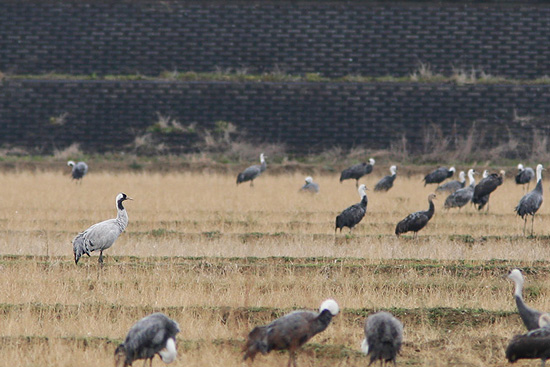
On Saturday 27th December 2008, I made a trip to one of the most famous birding spots in Japan, which is Arasaki in Izumi city, Kagoshima Prefecture. Kagoshima is the southernmost prefecture of Kyushu Island before reaching the Okinawa islands. The place is well-known for its 10,000+ migrating cranes that stay here every winter. Most of them are
Hooded Cranes, which, this year, the amount is
9,186 birds, and
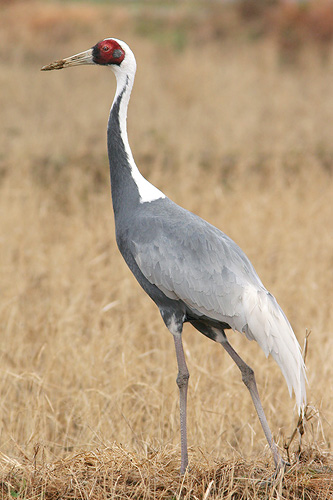
White-naped Cranes with the amount of
1,525 birds according to the Crane Observation Center website
http://www.city.izumi.kagoshima.jp/izumi_crane/08report/report2008_en.asp. Fortunately, there are also
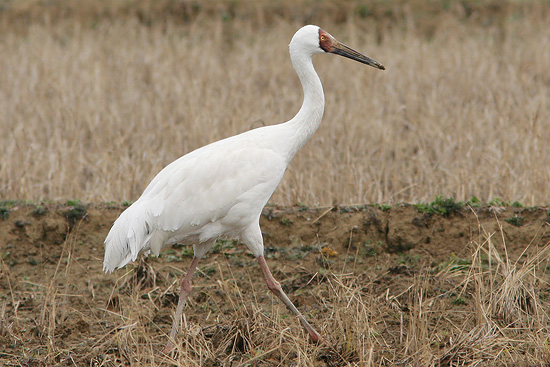
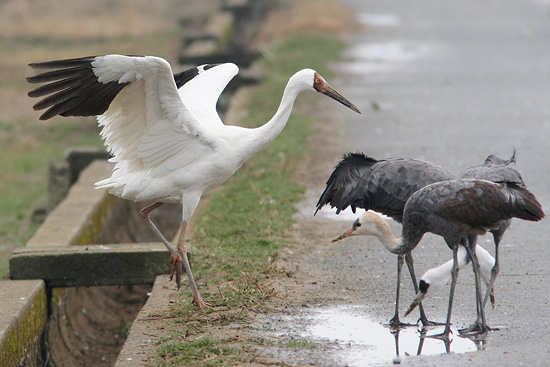
2 Siberian Cranes, which should be considered as a vagrant in Japan,
6 Sandhill Cranes,
5 Common Cranes, and
2 Hybrid Cranes(between Hooded and Common; even though the website said there is only 1) presenting this year in Arasaki also.
From 11.46 am I took a red Trans-Kyushu Limited Express train from Beppu to Kumamoto station. It was a very fine day with nice blue sky, and the scenery around Kumamoto was impressive. Then from Kumamoto station I had to take a Relay-Tsubame which will connect me to the Tsubame train, which is the Kyushu Shinkansen or Super-Express Train at Shin-Yatsushiro station. Then from Shin-Yatsushiro station, I arrived at Izumi Station in just about 15 minutes by the shinkansen. However, it was already almost 5pm when arrived at Izumi, so I had no chance for birding that day, since the day is so short in winter. The hotel I reserved was Hotel Wing which is just in front of the Izumi Station.

This one is the Trans-Kyushu Limited Express Train.

And this one is the Kyushu Shinkansen or Tsubame(meaning a Swallow in Japanese).
The next morning I took a taxi from Izumi Station to the Crane Observation Center. The sun still hadn't risen up but there was already some light in the sky. It took about 20 minutes or so from the Izumi Station to the Crane Observation Center. The taxi led me through vast rice fields and crossed few rivers, headed out of the city. Finally there were signs that telling me we're about to arrive, they were flocks of cranes! From what I could see were dozens of cranes silhouetting across the sky, which was already being paint with orange, pink and blue. The taxi stopped in front of the Observation Center, I jumped off and quickly paid, then set up my camera, and what had taken me so far from Beppu was right here in front of me!

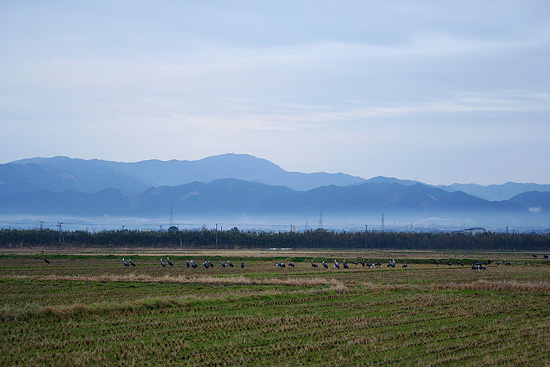
The area is mainly covered with flooded rice fields.
 And when the first sunlight hit the ground, the rice field turned into gold!

Hooded Cranes standing under the warm morning light.
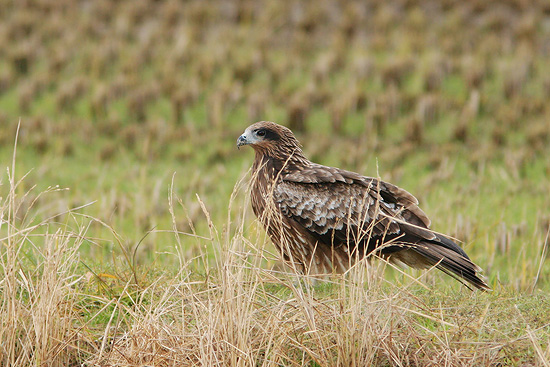
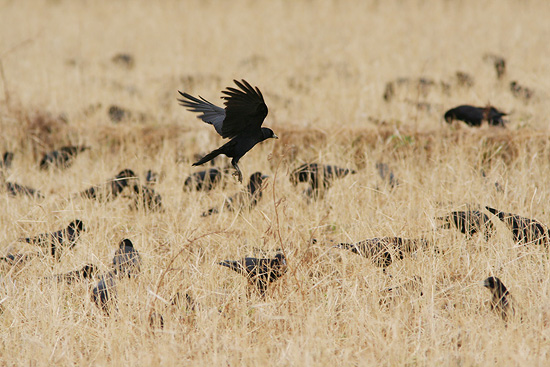
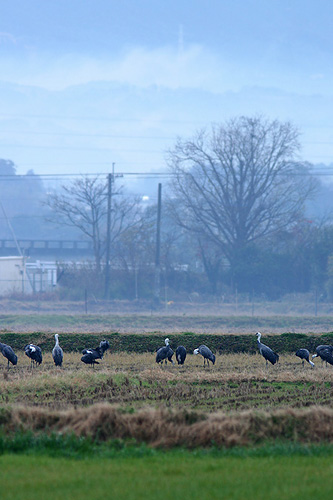
In front of me was a huge flock of Hooded and White-naped Cranes standing in the rice field just behind the Crane Observation Center. Not only there were cranes, but also other kinds of waterfowls were circling through the sky in a massive number. Birds were flying from everywhere heading to the Observation Center, since some officials went into the fields putting some kind of food for them. Flocks of passerines were also notable. There were hundred of Grey-capped Greenfinches flying around looking for some good places to land, and about 50 Russet Sparrows perching on the electronic wires. Bull-headed Shrike and Water Pipit were also presented well along the way around the Observation Center. Other common species included White and Grey Wagtail, Grey Heron, Little Egret, Common Snipe and Black Kite. On the other side of the field was a huge flock of Rooks, which is a Kyushu specialist. I was hoping that there might be one or two Daurian Jackdaws mixing in the 100+ flock, but I couldn't find any single one.

Flock of ducks landing behind the Crane Observation Center
Actually, I had a brief bare-eye view of an adult Siberian Crane flying among hundreds of other grey cranes since the first moment I arrived at the Observation Center, but I was still inside the taxi and the birds let me no chance to have any better view, so I kept wandering around the Crane Observation Center hoping for the bird to comeback again, though, finally it didn't. Its pure white plumage flashed up among the others with prominent black wing tips, making it easily spotted even though the flock was very big.
 A beautiful dawn at Crane Observation Center

Grey-capped Greenfinches flying around over the rice fields.
After walking along the road around the Crane Observation Center, I walked back to the main feeding area to watch the spectacle scene. Now that the sun was fully shone, the birds were also at the maximum number. Both cranes, ducks, and crows were totally feeding in madness! Even though there were only few species feeding in the area, I got a pretty good view of my new lifer, the Common Shelduck, which is also one of the Kyushu specialists. There were 3 or 4 of them walking around in the flooded field joining the numerous Eurasian Wigeons and Mallards far behind the crowd.

Love it...when all the cranes raise their heads up at the same time!

After a long while, I decided to walk from the Observation Center to the river, which leads to the Sea of Yatsushiro, east of the Crane Observation Center. According to my guide book, it says that there are usually flocks of ducks floating in the river. There were! In a massive number also. But the sad thing is, 99 percent of them were the same old Wigeons. The 1 percent left included few Northern Pintails, Mallards, and Shovelers. On the far side, I found a group of Great Cormorants drying their wings up on the bank. Also, there was a single Vega Gull floating along with the ducks. Along the roadsides, I found a flock of White-cheeked Starlings, Brown-eared Bulbuls, Japanese White-eyes, a single female Daurian Redstart, few Dusky and Pale Thrushes, and an adult Common Crane flying by in a group of Hooded.

An adult Hooded Crane flying over my head.

The river was packed with ducks.

Two female Mallards showing their white underwing coverts.
After a long walk I went back to the Observation Center. The cranes were still there, and there were groups of tourists with buses all around. Most of them were Japanese, but I found two or three groups of them speaking in Chinese also. Arasaki is not only popular among birders, but it also attracts Sunday visitors from all over Japan. In the rice field next to the Center, I saw 2 Eurasian Skylarks flushed up, and a non-breeding Zitting Cisticola perching on the top of the rice stem. Luckily, sunlight was plenty so I was happily shooting photos of the cranes during that afternoon. In the midst of the cranes flock, I found 1 Hybrid Crane, which looked like a Hooded with the body plumage of Common. There was also an Osprey soaring in a distance.

An adult Hooded Crane among thousands of his friends.

I found that shooting photos of cranes in flight was very enjoyable. They are big in size, slow-flying, and the sky that day was perfect. Sometimes they even fly closer to observe us, close as if I could feel the wind from their wing beats! Finally all my camera batteries went exhausted. I walked to the front of the Observation Center waiting for the bus, which operates from 10am to 4pm, to take me back to the hotel. While I was waiting, came a Japanese old man sitting and started chatting with me. He is a local Izumi people and knew about cranes quite well. He asked me did I see the Sode-kuro(Siberian Crane) yet, so I told him I already saw it this morning but it didn't come back to the Observation Center area, even though I've been wandering around looking for it for many hours. He laughed, and said it usually be like that. It's all up to time and chances. If you see it, then you saw it, but if you don't, mo matter how hard you search for it, you'll still couldn't find it. We talked about some other issues including the complications in Thailand, my home country, and my life in Japan. He also brought me a bag full of tangerines before I got into the bus.

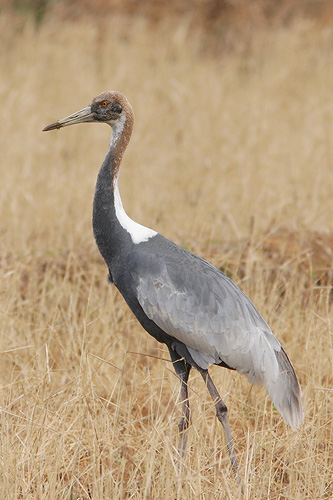
A nice comparison between adult and juvenile White-naped Crane


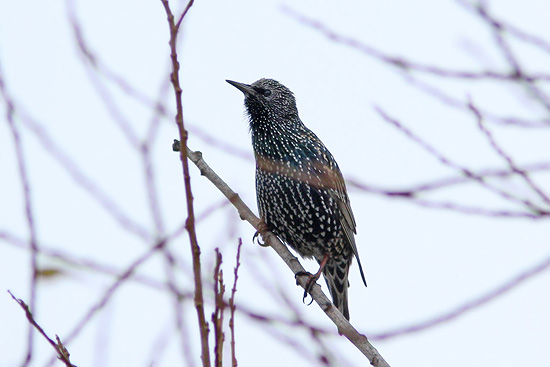
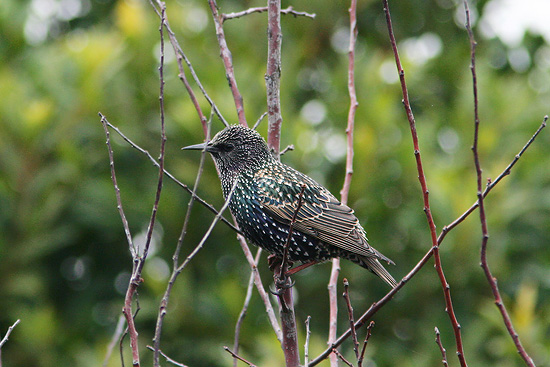
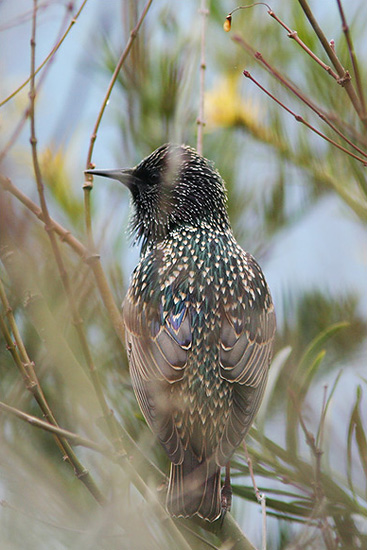
Also, I forgot to mention that along the electronic wires in front of the Crane Observation Center, there were flocks of Rooks perching all through the day. Sometimes other crows, like Carrion and Large-billed also join the flocks. As the bus departed, my eyes caught a single Common Starling perching openly on the electronic wire. The starling is a rare winter visitor to Japan, since it is specifically found only in Kyushu(again...), and Arasaki is also the first place where it was recorded. The bus crossed the bridge over the river I've walked to, and led me through vast rice fields on the east reclaimed land, which I read from the book, another good birding spot and a main natural feeding area for the cranes, but I didn't observe the area that day because it was too far from the Observation Center. Cranes were also plentiful along the roadsides. At one moment, I was thinking that there might be a chance for me to see the Siberian Crane again, but at the same time, I was hoping not to see it here, since all my batteries were exhausted. Ironically, I saw it. A graceful adult Siberian Crane standing just a few meters away from the road behind the observation blind, which was packed with birders and photographers. The bus couldn't stop, since it's not a bus stop, so it didn't stop, and it will not stop, even though how much I wanted it to stop. Anyway, I knew right then where I'm gonna be for tomorrow morning.

Winter is being decorated with the colorful Camelia.


 I took these photos of this pale crane on the last day at Izumi. It was feeding among the other thousands Hooded Cranes at the Crane Observation Center. I noticed that it has an unusual pale brownish-grey plumage, different from other juvenile Hooded Cranes, but I thought it might be some kind of variants. Until today, I just discovered that it was not a variant juvenile Hooded, but it was a typical juvenile Common Crane.


 An adult Rook in flight
 The juvenile bird has black feathers on bill base.

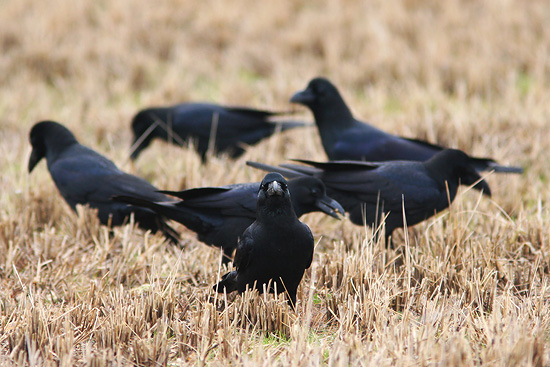
 Rooks feeding in the rice field
 Like other crows, Rooks also have bluish eyelid

 They perched on electronic wires in group.

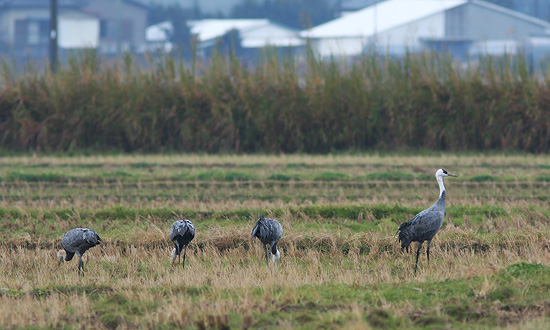
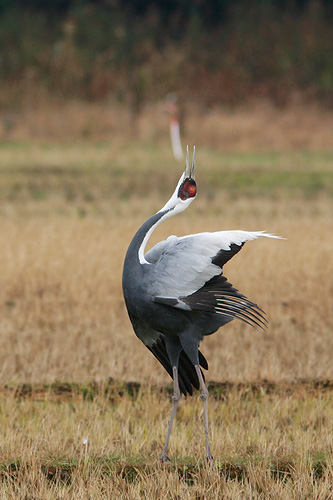
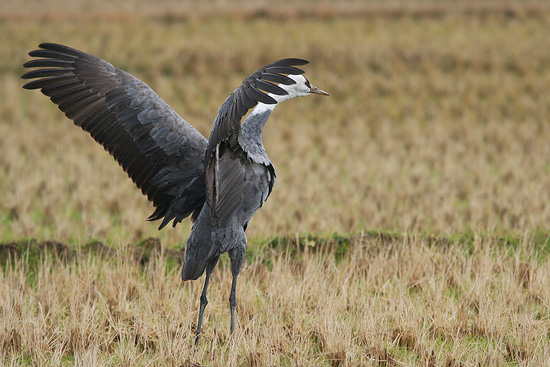
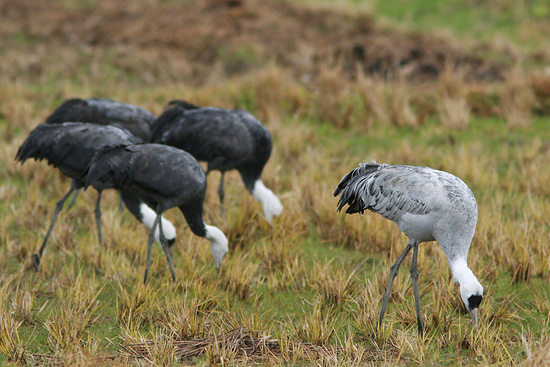
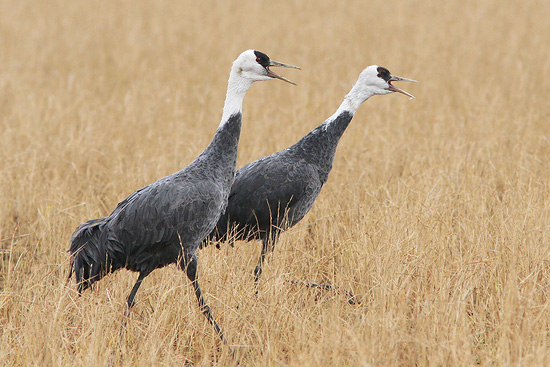 A pair of Hooded Crane calling while walking through the wheat field