Showing posts with label Rufous-winged Fulvetta. Show all posts

Tuesday, September 27, 2011

Little Brown Jobs

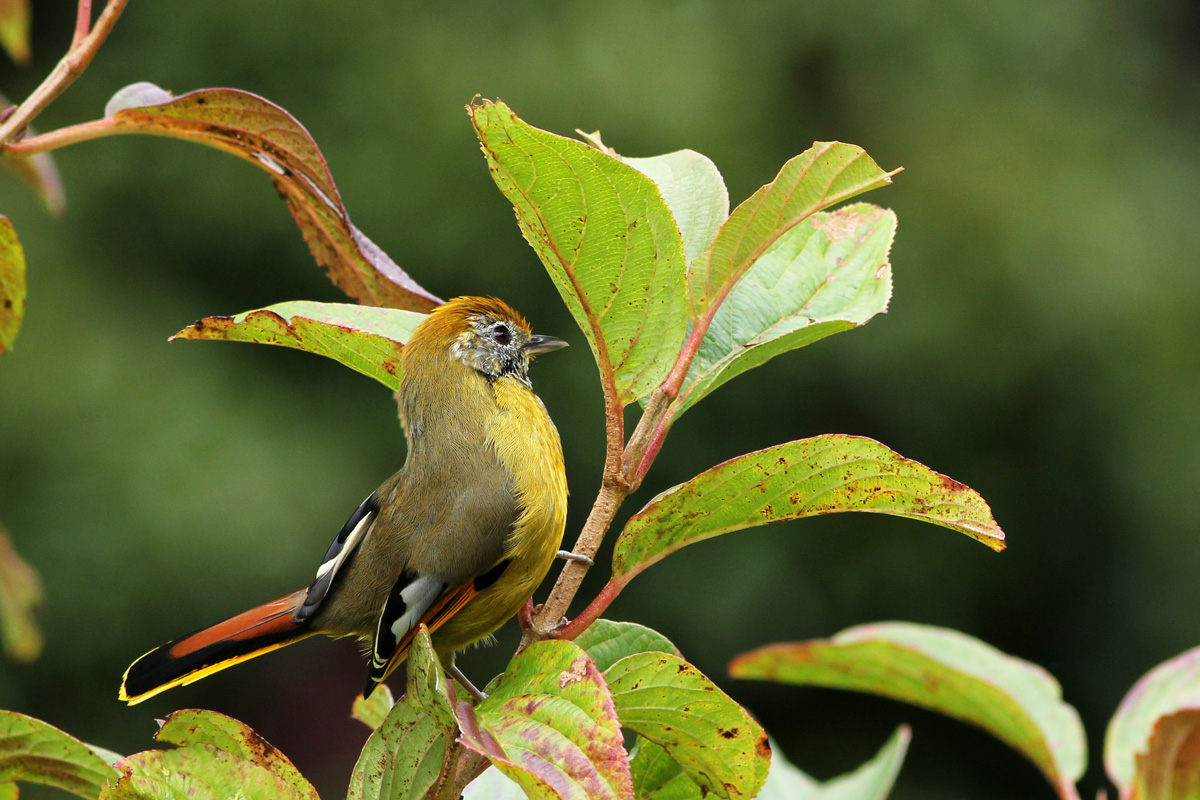
The LBJs are always fun to watch and very challenging to photograph! The whole afternoon of Sunday 18th saw me following flocks of LBJs all along the road near the summit of Doi Inthanon. The low vegetation along both sides of the road near the summit is the best place where you can encounter a handful of LBJ species, sometimes even some nice rarities. The party started with a huge flock of the tiny and restless Rufous-winged Fulvettas (Alcippe castaneceps). Not only do they hop around in the bush, they also spiral up and down the trees just like nuthatches to make us photographers feel dizzy as hell. I wasn't quite fond of following these tiny devils as they are quite common and widespread. The real thing started as a couple of Ashy-throated Warblers (Phylloscopus maculipennis) kicked in. This species of Phylloscopus warbler's distribution in Thailand is restricted to only the highest summit of Doi Inthanon. That reason alone easily made me decide to follow them instead of the fulvettas.
Ashy-throated Warblers (Phylloscopus maculipennis)
The Ashy-throated Warbler is even smaller than the Rufous-winged Fulvetta, only 9-9.5 cm in length and normally even harder to photograph! I've never been able to get any decent shot of this tiny warbler before. Didn't know why but the one you see in these photos was really obliging and posed for me so well. These small birds at the summit are not afraid of human at all since there has never been any human settlement in the past. It's very normal to watch them hopping around just before your eyes. However, being too close is surely not a good thing, so I had to constantly step back to get the whole body of the bird into the frame.

Ashy-throated Warblers (Phylloscopus maculipennis)

Rufous-winged Fulvetta (Alcippe castaneceps)
Taking care of the nuthatch's job
It was when I was enjoying shooting photos of the showy Ashy-throated Warbler that I saw 2 brownish birds flying into the bush in front of me. I was so happy to see that they were Yellow-browed Tits (Sylviparus modestus), a scarce montane forest resident. This species of tit always confuses new (or sometimes even senior) birders because it is so nondescriptive. Most people often mistaken it with warblers. However, if you look closely at its bill, you will see that it still has the tit's bill shape. Its yellow eyebrow is normally hidden by the olive-brown feathers but pronounced when displaying or alarmed. Shrubs around the summit of Doi Inthanon might be the easiest place in Thailand to see this northern montane specialty.
Yellow-browed Tit (Sylviparus modestus)

Bar-throated Minla (Chrysominla strigula castanicauda)
However, the most numerous LBJ of the highest summit of Doi Inthanon is the larger Bar-throated or Chestnut-tailed Minla (Chrysominla strigula castanicauda). It is also among the few Doi Inthanon's specialties. It can be found on a few high mountains in the west and northwestern parts of Thailand, but Doi Inthanon is the easiest place to find it. It has a nickname among Thai birders as the "Doi Inthanon's sparrow" comparing its abundance to the Eurasian Tree Sparrow which can be found literally everywhere in Thailand.

Mountain Tailorbird (Phyllergates cucullatus coronatus)
The last LBJ that I want to introduce in this post is the Mountain Tailorbird (Phyllergates cucullatus coronatus). Although it is not so drab and brown but its super skittish behaviour and its habitat fits nicely to the others. I can truly say that among all of the birds in this post, this one is the toughest to photograph. I found a pair singing and feeding in the same area for the whole morning near the 2nd checkpoint of Doi Inthanon and I spent the whole morning trying to get photos of them and the result was still not so satisfiable. This bird was extremely fast and always hid itself among the leaves and branches. Even when I tried using playback, it still didn't come out easily. I finally had to give up for lunch. Otherwise I'd be so damn angry bashing all the bushes around the checkpoint lol.

Monday, June 28, 2010

Evergreen Jewels (2)

One more post of my old photos taken at Doi Inthanon National Park. Apart from the 2nd checkpoint, there are lots of great birding spots within the park. The national park also holds the highest summit of the country at 2,565m above sea level. At the summit, a very important and unique ecosystem, which is the freshwater swamp forest, is formed. Unfortunately, due to mass tourism and heavy exploitation on resources, the habitats are dramatically degraded. The country's army uses the area of the highest summit as its military base and lots of precious ancient trees were sacrificed for the construction of many buildings. More and more constructions were done from year to year as being the highest summit of the country can always sell. Nowadays, tourists can drive through to the summit on a very well paved road, take photos with the sign showing 2,565m, drink Amazon coffee, buy some souvenirs and leave easily. It doesn't take more than half an hour for general tourists to sightsee the place. It's sad to see that most people don't realise how blessed they are to get such magnificent ecosystem within their own country.
The subspecies angkanensis of the Green-tailed Sunbird (Aethopyga nipalensis) can only be found at the summit of Doi Inthanon. It is one of the few endemic species of Thailand that cannot be found anywhere else in the world. The bird is the little jewel of the summit and can be seen easily even around tourism spots. It favours nectar from the flowers planted around coffee shops and the park's headquarter.

What makes it different from other subspecies is the bright scarlet patch on its breast.

The female doesn't look anything like her husband though.

Bar-throated Minla

Yellow-bellied Fantail

Rufous-winged Fulvetta

Not only the sunbirds that are found regularly at the summit, there are lots of other small birds that usually present near the tourism spots. Since these birds have no experience of being hunted by human, they are mostly very tame and approachable. Many species of them often come to pick up the leftovers from tourists.

Dark-backed Sibia

Pygmy Wren-Babbler

Rufous-throated Partridge

Among all species that are found at the highest summit, one of my most favourite birds would definitely be this Rufous-throated Partridge (Arborophila rufogularis). It is one of the few species of partridge that live in montane evergreen forest. Partridges and pheasants in Thailand are normally very scarce and difficult to see, but at the summit of Doi Inthanon, a flock of this Rufous-throated Partridge is often seen behind the headquarter's kitchen. The birds often come to pick up food from the leftovers after each cook, thus can be observed quite easily at close range by birders. Unfortunately, the kitchen was reconstructed and the forest behind it has been cut down. Nobody has seen the birds since then.

Sunday, June 27, 2010

Evergreen Jewels (1)

During this time of year, a large number of moths gathers together by the light from the 2nd checkpoint of Doi Inthanon National Park in Chiang Mai, Thailand. Electric light at the checkpoint is lit all through the night and in the morning, everywhere is filled with strange and interesting species of moths. This results in the abundance of small forest birds that come to pick up these easy foods. Every year, the checkpoint attracts lots of birders and bird photographers who come to see these beautiful jewels of the montane evergreen forest.
The brightly coloured male Yellow-cheeked Tit (Parus spilonotus) is one of the major stars of the checkpoint. Its bright yellow feathers sharply contrasted with black patterns along with the prominent crest can always impress any birders who see this beautiful little member of the tits family. The male bird has glossy black line starts from its chin down to the centre of its belly.

Here is the female. Note its duller yellow underparts with no glossy black line.

The Rufous-backed Sibia (Heterophasia annectans) is a member of the very large babbler family. Along with its common relative, the Dark-backed Sibia, it can be found regularly at the checkpoint during rainy season. It also has an impressive courtship display which male bird fans its wings and tail and puffs up its bright rufous back feathers to attract the female.

Another family of bird which can be found regularly at the checkpoint is the minivet. The most commonly seen species is the brightly coloured Grey-chinned Minivet (Pericrocotus solaris), which the male bird has a fiery orange plumage contrasting with grey head and upperparts, while the female bird has the orange colouration replaced by yellow.

Not only flycatchers, babblers and tits that usually come to the checkpoint, the Chestnut-vented Nuthatch (Sitta nagaensis) is also another regular visitor. Sometimes it can be so tame and comes down to the road to catch some dead insects. Because there are plenty of insects, mose birds become very tame and do not care much about the birders.

Grey-cheeked Fulvetta

Rufous-winged Fulvetta

As I have said that the babbler family is a very large and diversed group of bird, the main subfamilies of babblers that can be found here at the checkpoint includes the typical babblers, wren-babblers, scimitar-babblers, fulvettas, laughingthrushes, barwings and mesia. Most of them are normally skulking and very difficult to see in the open, but they mostly become much more approachable when there are lots of food like this.

The checkpoint is a good birding place even at night! The Brown Wood Owl (Strix leptogrammica) is a large forest owl which inhibits only in good evergreen forest. The checkpoint is the most well known place to look for this rarity. It often comes out to catch the horned beetles at night and can be found regularly just around the checkpoint.

Lastly, I'd like to end this entry with the super beautiful and truly a jewel of the montane evergreen forest, the Silver-eared Mesia (Leiothrix argentauris). It is arguably the most attractive star of the checkpoint. Normally, it is a very skulking bird that tends to hide in thick bushes but during rainy season at the checkpoint, it can regularly be seen in the open looking for food. It is also a close relative to the common and beautiful Red-billed Leiothrix which you all have seen quite often from my ealier posts. Next entry I will post more photos of birds at Doi Inthanon National Park.