'Water pheasants' reflects their similarity to 'pheasants'. This similarity gives rise to the Latin name Hydrophasianus as well as the official Chinese and Vietnamese names.
'Lily-trotters' and 'lotus birds' refers to their habit of walking on lotus leaves, a characteristic that is reflected in the Japanese name レンカク ren-kaku and the Chinese alternative name 莲角 ." (source http://www.cjvlang.com/Birds/jacanidae.html)
It's been more than 2 weeks now since I first found the Pheasant-tailed Jacana (Hydrophasianus chirurgus) at Sekino-e. It's the bird I've never expected to see in Japan. I wasn't even aware that the species exist here in this country. Though it is a common waterbird in tropical country like Thailand, I never got tired of watching it, especially in its magnificent breeding plumage. On Wednesday 25th last month, I surprisingly found one bird flying down into a lotus field while I was taking photos of the Whiskered Tern. I was so happy to find it here since it's a beautiful bird which I haven't got any decent photos of. However, the bird was way too shy for me to get any good shot in the first day. I later visit the place again in the next morning and this time I finally got some nice photos of the bird. It was still on its way moulting into a breeding plumage with some non-breeding features left on its face and underparts. Its elongated, pheasant-like tail is where the name's coming from. Unfortunately, the bird only stayed for 2 days so I couldn't have a chance to see it in its full breeding plumage. Hope I can find it again soon.


Look at those toes. Jacanas are equipped to walk on floating vegetation on the water surface, especially lotus.


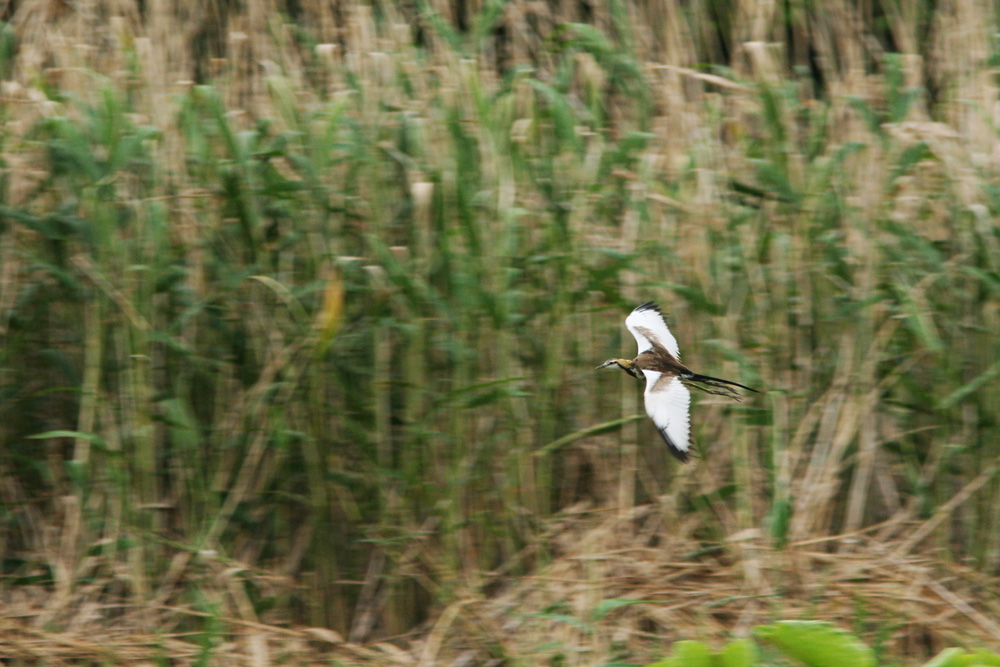
 Though it appears to be quite a small waterbird, it actually has a slow and beautiful flight. It looks very different in the air with its pure white wings. I tried to capture it in flight but the light was not so good and I couldn't get any decent flight shot of it. Anyway, you get the idea of how it looks like in the air.