
On January 29th, I went to Oita River with two of my Thai friends. It was the first time for me to find other Thai students who are also interested in birding in Beppu. We arrived there quite late and were disappointed to find many people paddling in the river. It seemed like they belong to some sort of a Sunday canoe club. Most of the ducks that were roosting along the riversides were flushed up and flew upstream. The paddlers were there for about half an hour and finally went further downstream. However, since we were late and the birds were disturbed, we didn't get to see many decent birds. I tried to look for the Green Pheasants which I found last time, but the grassy area along the river seemed to be cut recently and was too open for the pheasants, so we didn't see any. At least I managed to introduce many Great Crested and Little Grebes, Eurasian Wigeons, Northern Shovellers, Grey-capped Greenfinches, Great Cormorants and Ospreys. My friends had to leave around 10:30AM, so we said goodbye and I walked back to my favourite spot where I photograph the ducks.

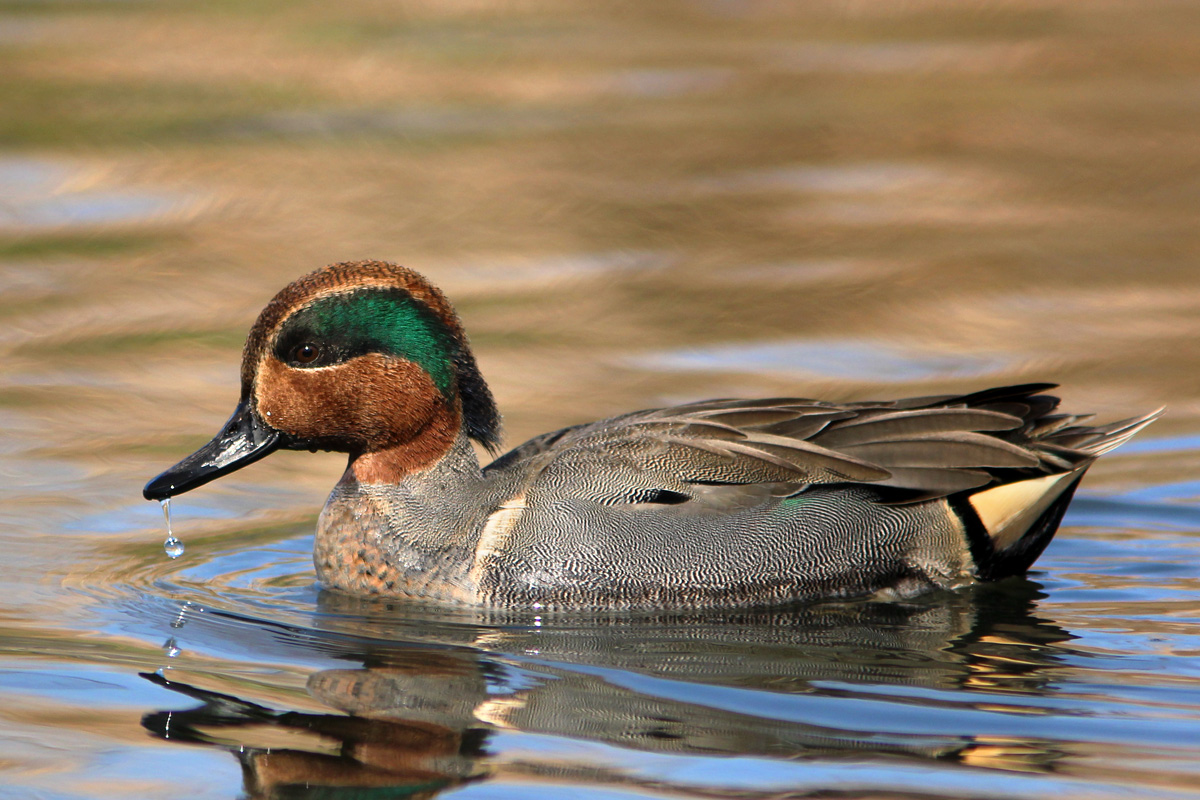
Green-winged Teal (Anas crecca carolinensis)


After I arrived at the spot, all of the ducks flushed up and landed in the middle of the river. I set up my hide and waited for them to come back to the feeding area. As I was scanning through the flocks of ducks in the middle of the river, my heart suddenly dropped when my eyes caught a single male Common Teal with shining white stripes of the sides of its breast. I was really surprised to find that I was looking at a Green-winged Teal (Anas crecca carolinensis), a very scarce winter visitor from North America. I've never expected to find this taxa in Oita before, so I was extremely happy. I kept waiting silently inside the hide hoping that the bird would come closer to the feeding site and it finally did, along with the other Common Teals and Northern Shovellers.


Adult male Green-winged Teal (Anas crecca carolinensis)


At first, the bird seemed to be more wary than the others and even flew out once it noticed my lens moving for the first time, but it later became more accustomed to it and finally came swimming right in front of the hide without feeling intimidated. It was really interesting to be able to observe both subspecies of Common Teal at close range. The white vertical stripes on the breast sides of the Green-winged Teal were much more obvious than I thought. I could see them clearly even from the distance. The bird also lacks the white horizontal line on the lower scapulars which is another critical identification point for distinguishing it from the male Common Teals. I also noticed that the breast seems to be more buffish than the Common Teals as well.

Comparison between Green-winged Teal and Common Teal


Adult male Common Teal (Anas crecca crecca)


Adult male Green-winged Teal (Anas crecca carolinensis)




Excuse me for posting too many repetitive photos of the same bird, but I don't think there will be many chances for me to photograph this rarity here in Japan, especially at this close range. The bird seemed to have exactly the same feeding behaviour with the Common Teals; dabbling in shallow water and occasionally walking on the banks. Wikipedia says that according to the DNA research, the Green-winged Teal is actually more closely related to the totally different looking Speckled Teal (Anas flavirostris) of South America than the Eurasian Common Teal. I find this information quite unbelievable. It is one of the reasons why many authors regard it as a full species. However, the American Ornithologists' Union (AOU) is still considering it as a subspecies of Common Teal.


Adult male Green-winged Teal (Anas crecca carolinensis)


God knows if any of these are female Green-winged Teals.


