Showing posts with label Blue Rock Thrush. Show all posts

Friday, November 4, 2011

Blue Rock Thrush

Yesterday, Russell wrote about a Slightly Silent Autumn in his blog, and I was surprised because the same thing is also happening here in Beppu. It's not that we always have such a lively autumn, but at least it has always been much livelier. The weather is also much different from the last one. It is much warmer than the same time last year. I can still wear the same clothes I wore in summer during the day and fully open my window at night without getting a cold. I was surprised looking at photos of myself taken around the same time last year wearing 2 or 3 layers of clothes. Coincidentally, I'm now reading a book called The End Of Nature by Bill McKibben. It mainly discusses about global warming and it is not pleasing at all to witness such a dramatic change in birds and weather around here, especially after having read the book with such title. The change feels almost tangible.

Female Blue Rock Thrush (Monticola solitarius philippensis)

I visited Rokushou-en on October 17, and it was one of those quiet, not so productive visits. There were only few birds along the shore, 3 Great Cormorants, 1 Common Sandpiper and a pair of Blue Rock Thrushes. That's all. At least, the rock thrushes were quite obliging enough, especially the female that came to pick up insects on the bench close to where I was sitting. The male bird was more skittish and wouldn't let me get too close. Even though it was in its non-breeding plumage, it still looked fine with its blue and chestnut plumage. The black, white and grey scales of the non-breeding plumage make it look a bit more rockier. Though the Blue Rock Thrush is quite common elsewhere, I find that I have few photos of this species. In fact, I've only photographed it properly once during the summer of 2010 when a family was found near Furuichi. Photos of the family can be seen here. I have to say that the male is quite attractive in its breeding plumage.

Non-breeding male Blue Rock Thrush (Monticola solitarius philippensis)

Friday, June 11, 2010

A Rock Thrush Family

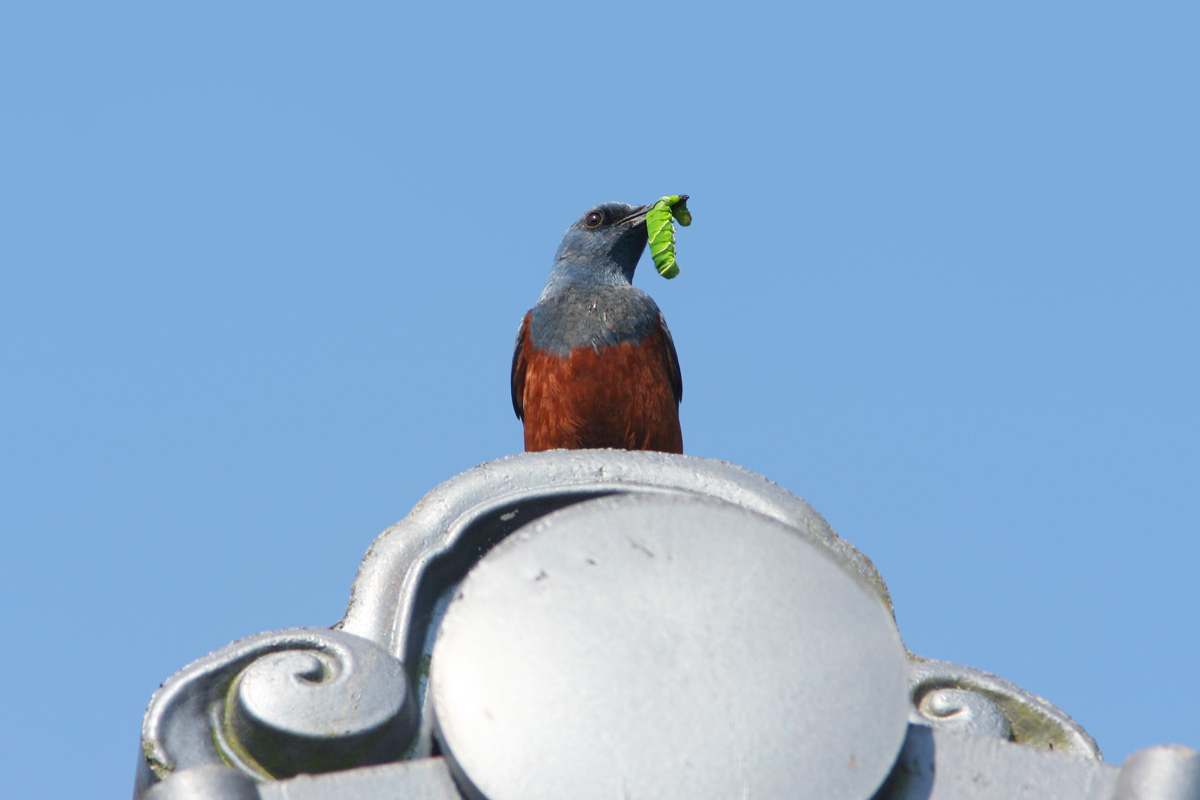
I found this family of Blue Rock Thrush (Monticola solitarius) at Furui-chi last Saturday. At first I found one fledgling hopping on the ground then followed by its mom. I later found 2 more fledglings flying and perching around all over the area. The male bird was the one that mainly brought food back for the youngs. Two chicks seemed to be male birds because they already had some bluish feathers on their wings and tails. Subspecies M.s.philippensis is the main subspecies in Japan. Unlike other subspecies, male bird of M.s.philippensis has bright chestnut belly and undertail coverts. It's a common species which can be found year-round around here.
A male bird feeding a young with a caterpillar (maybe Polyura sp.)

This one is the first fledgling I found. Note its bluish wings and tail.

Male M.s.philippensis has rich chestnut belly.

Another fledgling (female)

Here's the last fledgling. This one is also a male bird.
It still has a downy ear tuft on its left ear covert.

I almost got some great captures of the beautiful male bird once when the bird flew down to the ground close to me to catch a lizard, but unfortunately the sun was almost right behind the bird. I just couldn't move because the bird would definitely fly away as soon as I change my position, so I could only get this photo showing a beautiful male bird with its prey prey in a very ugly lighting condition.

Thursday, April 8, 2010

Time For Foods

It's spring, and it's still a spring vacation, so I've got plenty of time to go out birding. The results lie in my external hard disk. Here are more photos from the same visit to Rokushou-en last week on April 3rd. Lots of people were gathering at the rocky beach searching for seaweeds and oysters. It almost looked like a festival. Not only there were many people, there were also lots of Grey Heron flocking for food as well.
One of the many breeding Grey Herons

This one is still a non-breeding.

Most of the birds looked beautiful in their breeding plumages. The bare parts like bill and legs turned into colourful reddish-pink and orange, and the lores turned into deep blue. However, they'll soon disappear to Honshu and Hokkaido where they mostly breed. Only few couples stay around Beppu throughout the year.

The male Blue Rock Thrush was also in his most handsome suit.

But something was really wrong with his wife's beak.